
Published On
September 22, 2026
Authors
Addressing Financial Barriers to an Effective Regional Cancer Service Line
Supporting the Vision for Patient-Centered High-Quality Care Close to Home
Hospitals across the country are moving into regional health systems to elevate the level of care and outcomes for patients, expand their patient base, increase efficiency and strengthen financial performance, and patients are increasingly seeking high-quality convenient care close to home. Academic health systems (AHSs) are working to leverage their brand and specialty expertise through distributed specialty care models that strengthen community-based locations and preserve scarce capacity at the flagship hospital or academic medical center (AMC) for the most complex patients. Although many regional health systems are financially integrated and have consolidated business, administrative and support functions for scale, they have had less success organizing regional clinical service lines into system-wide programs. Without an effective system-level service line view of financial performance, there are barriers to effective region-wide programs.
Cancer is often a priority regional service line because there is growing demand, it is financially important to community and academic providers, and patients increasingly want treatment close to home. As discussed in our paper , organizing care across entities requires a regional, clinical practice model, physician engagement across employment and private practice arrangements, standardized care and program components, and governance with clear management decision rights. Regional integration requires system-level financial performance accountability. When financial accountability is established solely or predominantly at the local level, individual hospitals, physician organizations, faculty practice plans, ambulatory operations and other entities have overwhelming incentives to optimize their own financial performance, which may undermine a system-led distributed cancer strategy. The system cancer service line executives face has many points of resistance as decisions that are financially beneficial at the system level will invariably have a negative impact for some entity, department or division. Planning must therefore address financial impacts across entities, incorporate those impacts into budgets and targets, and provide executives with not only the information needed to resolve conflicts, address barriers and monitor progress, but the managerial incentives to do so.
Regional cancer service lines can fulfill the promise of patient-centered, high-quality care close to home only when clinical operations and financial management are aligned. Alignment begins with governance and system-level management. When there is a lack of alignment around system-level priorities and clarity over decision rights, regional integration is more difficult. Once effective service line governance is established, executive leadership must enforce decision rights, resolve entity-level conflicts and monitor performance against system-wide goals.
Establishing cancer service line financial management and reporting in AHSs
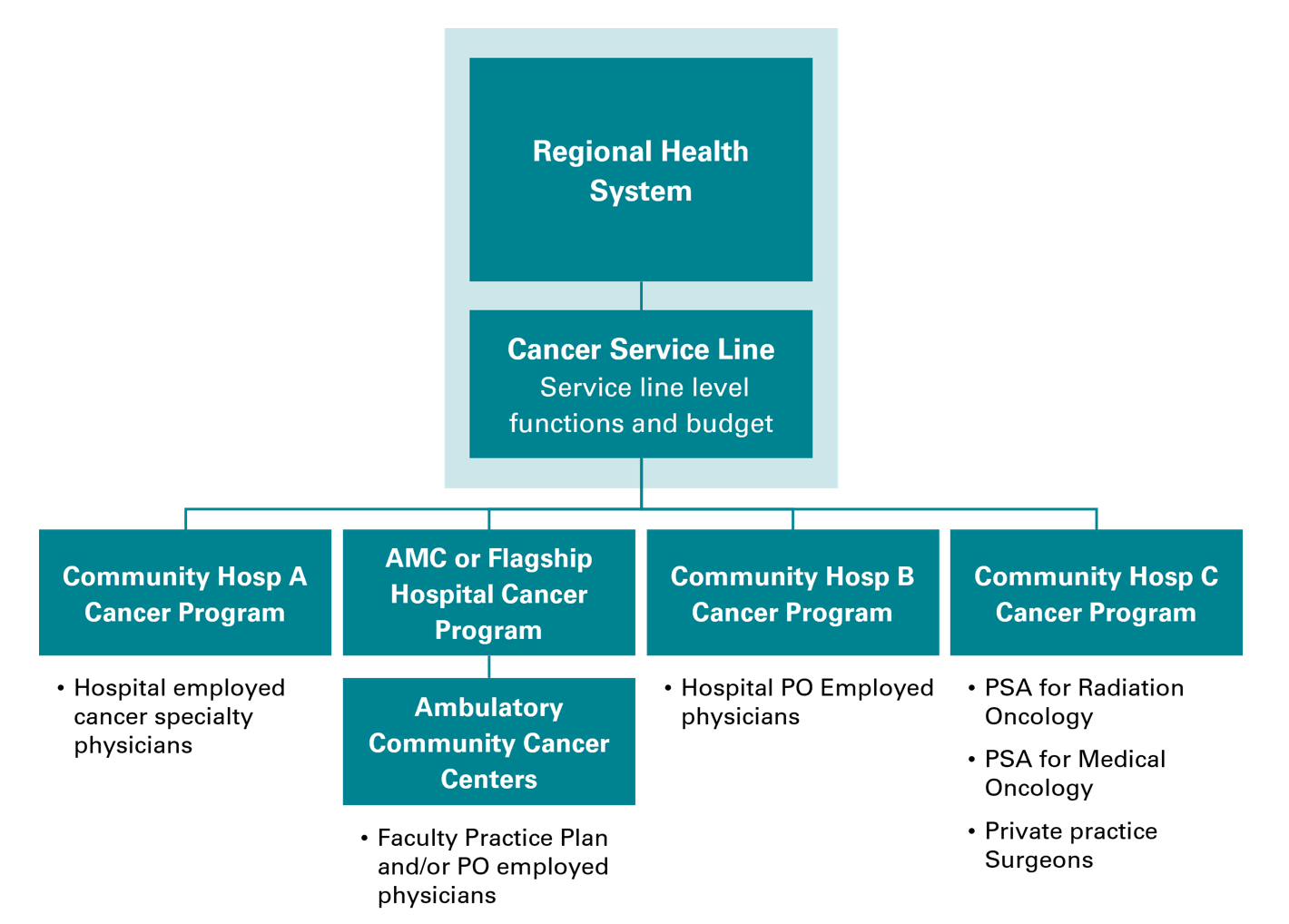
AHSs, which include AMCs and community hospitals of varying size, have inherent structural complexity that challenge integration. That complexity includes differences in physician alignment models, program components, productivity expectations, and variation in academic and community hospital capacity and priorities. Figure 1 illustrates some of the structural complexity that must be addressed for a regional cancer program integration to be successful.
Preparing a System-wide Cancer Contribution Margin Analysis
The initial step in developing a regional cancer service line financial management model is to define the service line’s clinical and operational scope. Inpatient hospital cancer units and other hospital-based services may be excluded from the managerial component of the regional service line, but service line financial reports should be inclusive of inpatient and other service type results to support informed decision-making. Centralized system-level functions and staff—such as administration, registry, quality, data analytics, IT, financial management and cancer clinical trials support—should be allocated to the service line management cost center(s) with clarity, transparency and consistency. Data analytics and financial management support are especially important to support this and require dedicated personnel.
A foundational planning step is developing a baseline service line contribution margin (CM) analysis that identifies cancer patient encounters and maps them to major disease sites. Appendix 1 is an illustrative table of CM % across entities for commonly used cancer disease categories; some organizations may use more disease categories based on volume and program priorities. Using patient encounter data, the CM analysis should show system totals in dollars and percentages, with breakouts by location, service type, payor category and disease site. Service breakouts should include major cancer-related services such as provider clinics, infusion therapy, radiation therapy, diagnostic imaging, ambulatory surgery, inpatient care and physician margins from the physician organizations across the system where feasible. Specialty pharmacy margins should also be reported and tracked, even if they cannot be incorporated fully into the CM analysis.
The baseline model can support a three- to five-year financial projection that reflects site-of-care assumptions, capital needs, entity-level impacts, budgets and financial targets. It should also reflect the time needed for a distributed care model to mature and improve performance. With this information viewed with quality, access and patient experience data, leaders can benchmark margins by disease site and location, identify trends, guide improvement initiatives, monitor external changes, and inform investment and outreach decisions.
System leadership should receive a summarized operating report and CM analysis quarterly, with presentation to an executive committee or cancer steering committee as defined in the governance plan. Even when governance and system-level accountability have been established, entity-focused cultures can endure, creating barriers to system-wide effectiveness and performance improvement. Executive leaders may need to intervene, especially in the first year, to keep the distributed regional cancer program on course. As Case Study 1 and 2 illustrate, financial data can help leaders resolve barriers at either the AMC or community hospital level and make decisions that benefit the system overall and patient care.
Case Study 1. Using data to shift AMC resources to a community hospital breast cancer program A strategically important community hospital with a favorable payor mix was losing breast cancer patients to a competitor that had added a breast medical and surgical oncologist. Margins were dropping for radiation therapy and infusion, and referrals to breast surgeons at the AMC also declined. The community site requested breast medical and surgical oncologist sessions from the AMC to compete locally. Surgeons agreed, but the AMC medical oncology division director resisted, despite constrained AMC clinic space and excess provider capacity in this clinic, because he did not want to lose some of the clinical time of a breast specialist. The service line leader did not have the authority to make this change and the loss trends continued. With a new CM analysis, data on volume and financial losses were presented to executive leadership with return-on-investment modeling. Leadership used the data to speak with the chair of medicine and the president of the physician organization, and the division director was directed to have one breast oncologist assigned for sessions in the community. This improved local access and loss of patient volume, in the clinic, infusion center and in radiation therapy, strengthened the breast program in the community, improved clinical productivity in the breast clinic at the AMC, increased surgical referrals, and freed AMC capacity in the oncology clinic for more complex care in other growing disease areas. |
Case Study 2. Using data to resolve an impasse between the AMC and community hospital cancer program A community hospital cancer program within a regional AHS had a professional services agreement with a private practice oncology group. The hospital was losing complex, high-margin GI surgical patients to a competing AHS, where the private practice group was referring patients instead of to their system AMC. The service line leader sought AMC GI surgery clinic sessions in the community and they agreed. The community hospital president did not want the expense of a GI surgical clinic without having the GI surgical procedures performed locally to increase revenue, despite the fact that the expertise to manage the patients in the operating room and post-operatively was not sufficient. This created a yearlong impasse. After the completion of a CM analysis, the service line executive presented data on the volume and revenue loss for the system and quantified the opportunity to improve it to executive leadership. With this financial data and quality considerations, the local hospital president was advised to support the AMC surgeon and service line executive recommendations to hold GI surgical sessions in the community with surgical procedures performed at the AMC when advised. This decision led to better access to specialty expertise for patients in the community and for more complex cases to be referred to the AMC, which benefited the service line and system overall. |
Steps to be taken to strengthen the financial management of regional cancer service lines
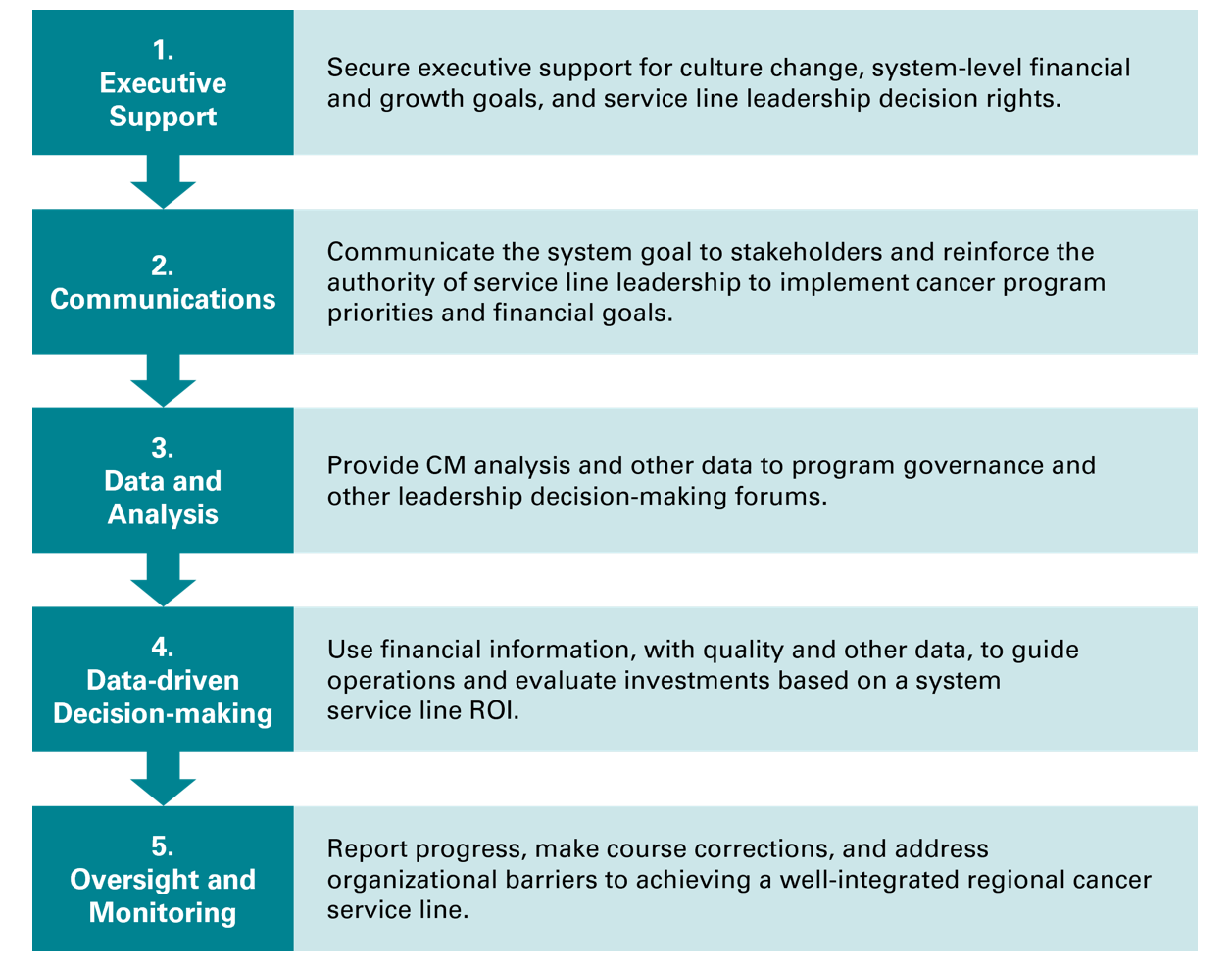
After deciding to develop a distributed regional cancer service line that provides care closer to home while supporting system growth and financial performance, health systems should take the following actions:
Conclusion
To integrate a cancer service line regionally, an AHS must develop a transparent, system-level view of resource distribution, decision rights (governance and operational) and accountability for performance (access, service, quality and financial). Tension between system and local financial performance must be resolved, with management incentives aligned with organizational priorities. Continuous analysis of market, quality, operational and financial data supports decision making focused on patient outcomes and wellbeing and overall system performance.
When effectively realized, regional cancer service line integration strengthens community-based care, meets patient desires for care close to home, preserves scarce AMC capacity for the most complex cases, and supports growth and stronger financial performance.
Appendix 1
Illustrative Contribution Margin % by entity and disease
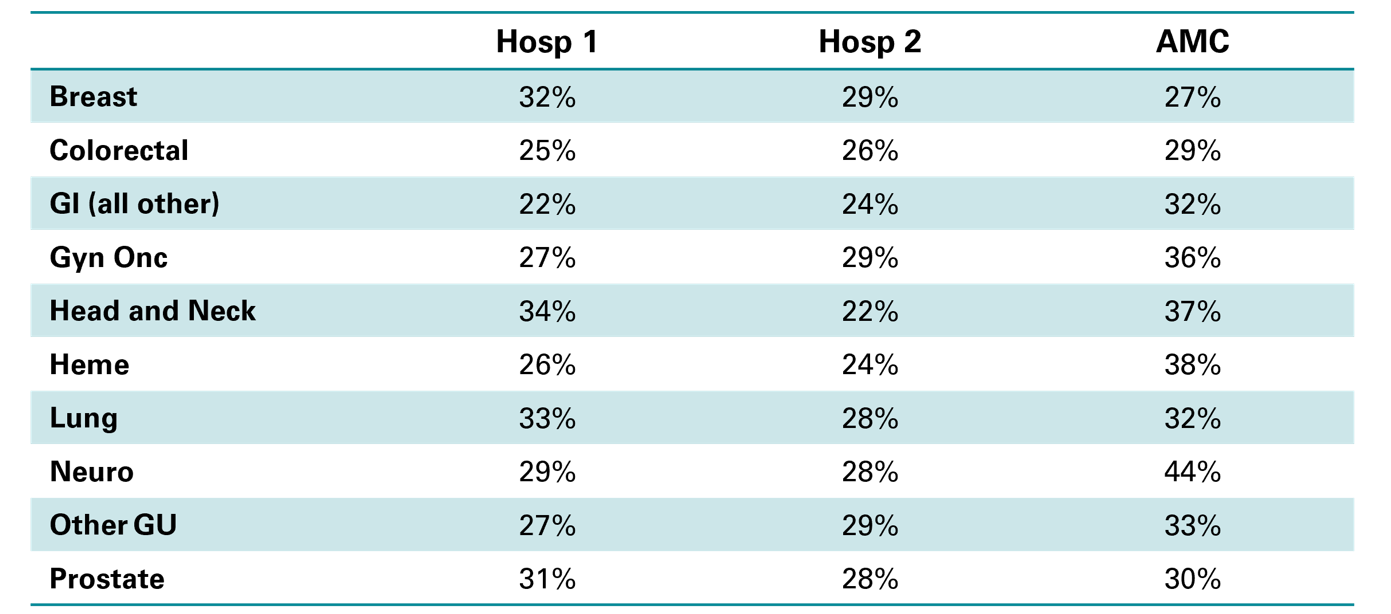
Leadership would look at this data and review the underlying detail to understand the influencing factors. For example, a low CM % for Breast at the AMC could be from an unfavorable payor mix and a high CM % for Heme Malignancy at the AMC may be the result of a high case mix index for inpatients. When delving into service type, other trends affecting margins can be identified such as de-escalation of radiation therapy and surgery in some disease areas or a high-cost, new treatment. |
Enders T, Brown D, Robertson T, Governance Renewal for Health Care Systems: Managing the Transition to Operating Company Models. Manatt White Paper, May 2026.
Fracasso PM, Simone NL, Si Lim SJ, Reckamp KL, Sosa JA, Lieu C, Lee C, Werner TL, Ly QP, Vose JM, White J, Honeycutt H, Shaw K, Cameron K, O'Brien DM, Wilke LG. Benchmarking the Current Landscape: Insights From an Association of American Cancer Institutes Survey on Academic Cancer Service Lines. JCO Oncol Pract. 2025 Sep 24:OP2500073. doi: 10.1200/OP-25-00073. Epub ahead of print. PMID: 40991878.
O’Brien D, Pawlak B, Ingraham M, Optimizing Regional Cancer Service Lines: Challenges and Strategies. Manatt Health Highlights paper. May 25, 2026
