
Published On
October 1, 2026
Authors
CMS Advances Medicaid Reentry With Five New Approvals and Key Policy Changes
In late September 2026, the Centers for Medicare and Medicaid Services (CMS) affirmed its continued commitment to Medicaid reentry initiatives for justice-involved individuals, approving new Section 1115 Reentry Demonstrations for , and and renewing and the Whole-Person Care demonstrations with new reentry authority. All five approvals are effective October 1, 2026 and are the first Reentry Demonstration approvals under the current Administration. They join 18 states already at various stages of implementation, bringing the total to 22 states and D.C.—or nearly half the country—that are working to make targeted services available to individuals in the period prior to release. The approvals reflect a recognition of the importance of maintaining continuity of care as individuals transition from incarceration back to their communities and of Medicaid’s role in supporting that transition.
Alongside the Demonstration approvals, CMS also released a set of (FAQs) clarifying and, in several areas, modifying its Reentry Demonstration policies. Together, the approvals and FAQs provide the clearest indication to date of how CMS intends to approach Reentry Demonstrations under the current Administration. Both reiterate the program’s core goals—improving access to health care services before release; reducing deaths and poor health outcomes after release; and strengthening coordination among Medicaid agencies, correctional systems and community-based providers—while placing new limits and an emphasis on program guardrails. The FAQs and approved Demonstrations also signal that CMS will continue to preserve state flexibility in program design, including decisions regarding eligible populations, participating facilities and covered services beyond CMS’ minimum requirements.
Notably, CMS introduces several policy changes that, in some instances, may make implementation more challenging for states: a shorter pre-release service period for individuals in adult facilities (a limit of 60 days, rather than the previously approved 90 days); a new reinvestment framework that requires states to calculate reinvestment obligations based on actual, rather than projected, federal expenditures; and a shift away from providing federal matching funds for transitional non-service expenditures—the infrastructure and capacity-building investments made available to states under earlier Demonstration approvals to help stand up their programs. States with pending Demonstration applications or future renewal requests should view these approvals and FAQs as an important roadmap for CMS’ expectations going forward.
Background on Reentry Section 1115 Demonstrations
Federal law, commonly referred to as the “inmate exclusion,” generally prohibits federal Medicaid payment for services furnished to individuals who are incarcerated. Reentry Section 1115 Demonstrations, first made available to states through CMS’ April 2023 State Medicaid Director Letter (), allow states to receive federal financial participation (FFP) for a targeted set of Medicaid-covered services delivered in the period immediately before release from prisons, jails and youth correctional facilities. These pre-release services must be designed to support the proactive identification of physical and behavioral health needs, improve care transitions as individuals reenter the community, and reduce morbidity and mortality post-release. The SMDL also sets out the minimum requirements states must meet to obtain a Reentry Section 1115 Demonstration approval, as well as areas of flexibility states have in how they operationalize the program. At a minimum, states must cover case management, medications for addiction treatment (MAT) and a 30-day supply of all prescription medications in hand upon release and may elect to cover additional services.
What the Recent Demonstration Approvals Include
As in prior approvals, CMS required the minimum set of pre-release services while allowing states to tailor other design features within the SMDL #23-003 framework. Table 1 summarizes the key design features of the five recently approved Demonstrations. The most notable variation is in participating facilities and adult eligibility. Louisiana and Minnesota do not include youth correctional facilities; Minnesota also includes adult tribal correctional facilities; and D.C., which does not operate a state prison, includes only jails and youth correctional facilities. Minnesota and Nevada established physical and behavioral-health specific eligibility criteria for adults, while D.C., Louisiana and Maine will include all Medicaid- and CHIP-enrolled individuals in participating facilities. All five states have elected to cover additional state-specific services beyond the required minimum, as described in Table 1 below.
Table 1. Key Design Features of the Five Approved Reentry Demonstrations
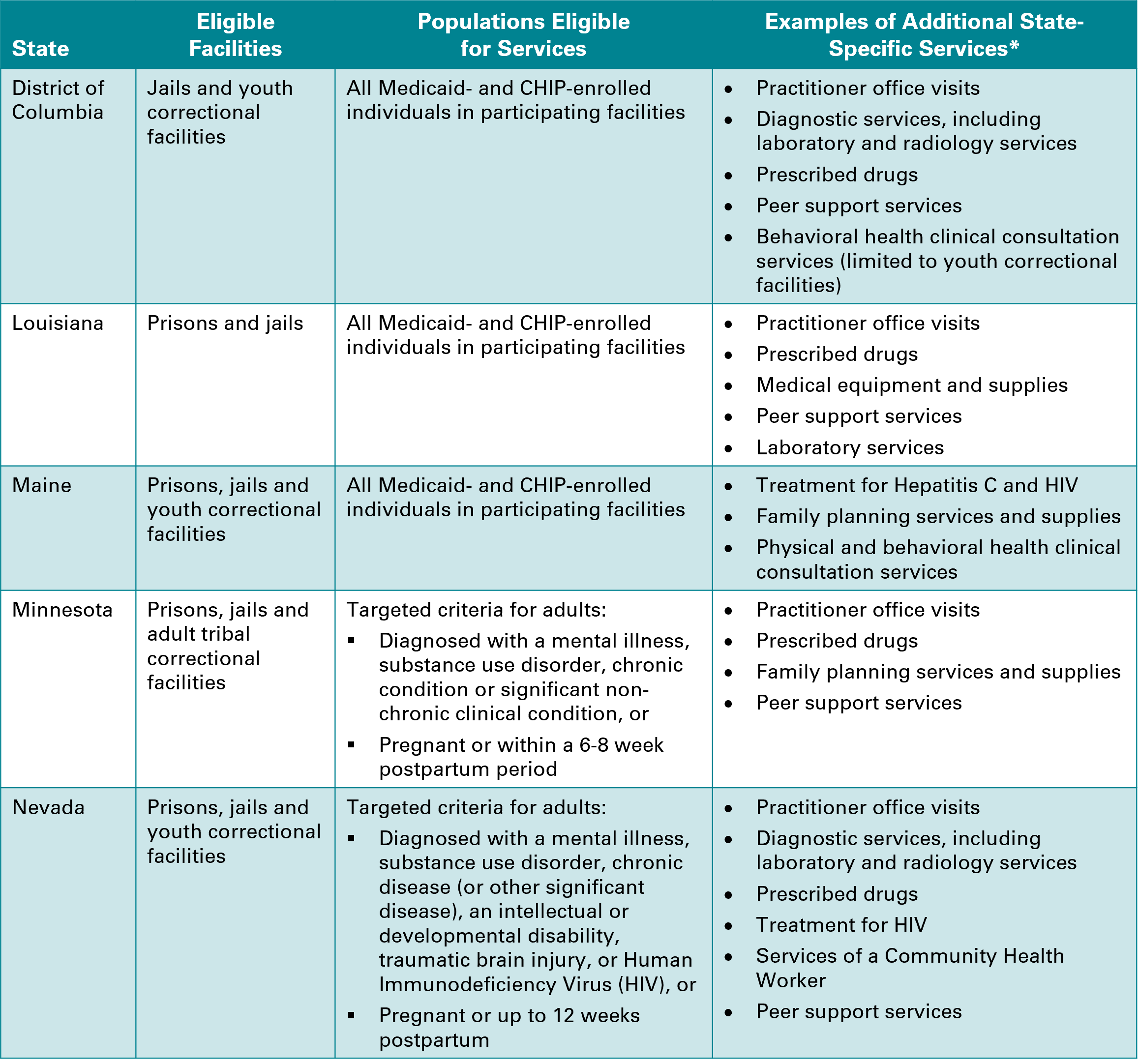
* All five Demonstrations cover the required minimum services of case management, MAT and a 30-day supply of medications upon release.
Policy Changes Reflected in the FAQs and Approvals
Shorter Pre-Release Period for Adults. CMS has determined that for future approvals up to 60 days of pre-release coverage, rather than the 90 days contemplated in the SMDL, is appropriate for individuals in adult prisons, jails and tribal correctional facilities. CMS cites evidence that access to services such as MAT in the 60 days before release reduces overdose risk, and it concludes that 60 days is sufficient to stabilize individuals, provide adequate case management and test whether pre-release services improve care transitions. CMS will continue to approve up to 90 days of pre-release coverage for individuals in youth correctional facilities. CMS also clarified that the approved pre-release period will be tied to facilities rather than individuals, as it would be unduly burdensome to offer different lengths of pre-release coverage to individuals incarcerated in the same facility.
In practice, the shorter window may be challenging for many states. The value of the 90-day pre-release period has not necessarily been that individuals require, or states expect providers to bill for, a full 90 days of intensive services. Rather, the longer window provides important operational runway to identify eligible individuals; connect individuals with care managers who may need to enter correctional facilities and establish relationships before release; assess physical and behavioral health needs; and schedule appointments, arrange medications and make other connections to community-based providers and services that will need to be in place upon release. Compressing this work into 60 days may make it more difficult to establish a meaningful pre-release relationship and ensure that the post-release care plan is operational by the time an individual returns to the community.
Reinvestment Tied to Actual Federal Expenditures. Under SMDL #23-003, states must reinvest the total amount of federal matching funds received for pre-release services that were previously funded by correctional facilities into activities that improve access to and quality of health care for people who are incarcerated or recently released. In the FAQs and the newly approved Demonstration, CMS has tied a state’s required reinvestment to the actual FFP received for existing pre-release services rather than the projected FFP reflected in the Reinvestment Plan that is approved at the start of the Demonstration. CMS will require states to recalculate the obligation annually through monitoring reports and to complete a final reconciliation, the Final Reinvestment Assessment, after the Demonstration period ends.
This shift will be extraordinarily complex to implement. States will need to reconcile Medicaid funding annually against services and expenditures that correctional facilities may already have been funding, and the final reconciliation could require them to take on additional fiscal obligations. States should expect to build detailed service-level expenditure and FFP tracking mechanisms, consider how implementation sequencing affects their exposure and plan for a flexible implementation strategy that can account for a shifting reinvestment target over time.
No Transitional Non-Service Expenditure Funding. All five states requested transitional non-service expenditures to support implementation of their Demonstrations, but CMS did not approve these requests. Under earlier Demonstrations, these funds provided critical start-up resources to correctional facilities to establish the infrastructure necessary to implement pre-release services such as IT and data-sharing systems, correctional facility workflows and staffing, and cross-sector collaborative planning. Without this funding, states should anticipate that fewer correctional facilities, particularly those with limited existing health care and administrative infrastructure, may be willing or able to participate in the Demonstration.
Enhanced Monitoring and Reporting Requirements. CMS is replacing the mid-point assessment with a Reentry Early Implementation Rapid Cycle Report, due 180 days after go-live rather than around the second or third Demonstration year, that focuses on early operations, program integrity and financial oversight. This is a reasonable change that more accurately reflects the implementation lifecycle of Reentry Demonstrations, which typically take 18 months to two years to stand up, and appropriately focuses reporting on the period after services have launched.
Meanwhile, States Continue to Build Toward Full CAA Compliance
These approvals come as states continue to implement Section 5121 of the Consolidated Appropriations Act (CAA) of 2023, which took effect January 1, 2025. Section 5121 requires states to provide eligible post-adjudicated youth with (1) screening and diagnostic services in the 30 days before release or within one week after release and (2) targeted case management in the 30 days before and at least 30 days after release. Many states’ Section 5121 state plan amendments were approved on a time-limited basis, with outstanding implementation requirements to be completed by December 31, 2026. Many states are phasing in implementation, beginning with facilities that serve the largest numbers of CAA-eligible youth, and some may need additional time beyond year-end to achieve full statewide implementation. For states also operating a Reentry Demonstration, CMS clarified that overlapping pre-release services for CAA-eligible youth may generally be provided and claimed through the Demonstration, simplifying implementation and avoiding the need to distinguish between authorities for individual services.
Looking Ahead
Manatt will be tracking several developments over the coming year. Four states—Arkansas, Connecticut, New Jersey and New York—still have Reentry Demonstration requests pending with CMS, and future approvals will provide further insight into whether CMS continues to apply the policies reflected in this latest round. States with existing approvals will also need to assess how these changes are applied at renewal, with California’s CalAIM Demonstration, which expires December 31, 2026, providing the first test case. As foreshadowed in the FAQs, forthcoming CMS guidance and an updated Implementation Plan template should provide additional clarity on monitoring, oversight and financial requirements. At the same time, implementation in newly approved states will test approaches to service-level tracking and reinvestment while states continue working toward full CAA compliance and, where applicable, alignment between CAA and Reentry Demonstration operations.
