
Published On
November 19, 2026
Authors
DOJ, HHS Streamline Health Care Fraud Self-Disclosure With Coordinated Criminal and Civil Pathways
In the span of one week, the U.S. Department of Justice (DOJ) and the U.S. Department of Health and Human Services (HHS) published separate, coordinated self-disclosure pathways for potential health care fraud. On October 15, 2026, DOJ’s National Fraud Enforcement Division (Fraud Division) and the HHS Office of Inspector General (HHS-OIG) issued a directing self-disclosures of potentially criminal health care conduct to DOJ. On October 22, 2026, DOJ’s Civil Division and HHS a six-month pilot program for potential civil violations of the False Claims Act (FCA), the Healthcare FCA Self-Disclosure Pilot Program (FCA-SDPP). Each pathway pairs DOJ benefits with related HHS administrative protections through a single disclosure, reducing the duplication and uncertainty of the prior patchwork of separate agency programs.
Background: Who Enforces What
A single course of conduct, such as a kickback arrangement, can expose a health care company to overlapping liability. The FCA reaches anyone who knowingly, or with reckless disregard, submits or causes a false claim for federal payment, and it carries significant penalties. Criminal statutes, such as the health care fraud statute and the Anti-Kickback Statute (AKS), require proof beyond a reasonable doubt and a more culpable state of mind. HHS-OIG may also impose civil monetary penalties (CMPs) and exclude companies from federal health care programs, often releasing its permissive exclusion authority in FCA settlements only if the company enters into a Corporate Integrity Agreement (CIA). The Centers for Medicare & Medicaid Services (CMS) may also revoke Medicare enrollment.
Before October, four separate self-disclosure mechanisms each addressed a different slice of that exposure:
- DOJ’s Corporate Enforcement and Voluntary Self-Disclosure Policy (CEP): criminal declination for companies that self-disclose, cooperate fully and remediate promptly, absent aggravating circumstances.
- Justice Manual § 4-4.112: discretionary credit in civil FCA matters, with no set multiplier.
- HHS-OIG’s Health Care Fraud Self-Disclosure Protocol (SDP): resolves CMP liability only, generally at a 1.5x minimum multiplier and with a presumption against a CIA. It cannot release FCA liability.
- CMS’s Voluntary Self-Referral Disclosure Protocol (SRDP): resolves Stark Law overpayments only. CMS may reduce the amount owed but is not required to.
Companies had to decide which agency to approach first, and whether a disclosure to one would protect them from investigation by the others. The October policies largely address this issue.
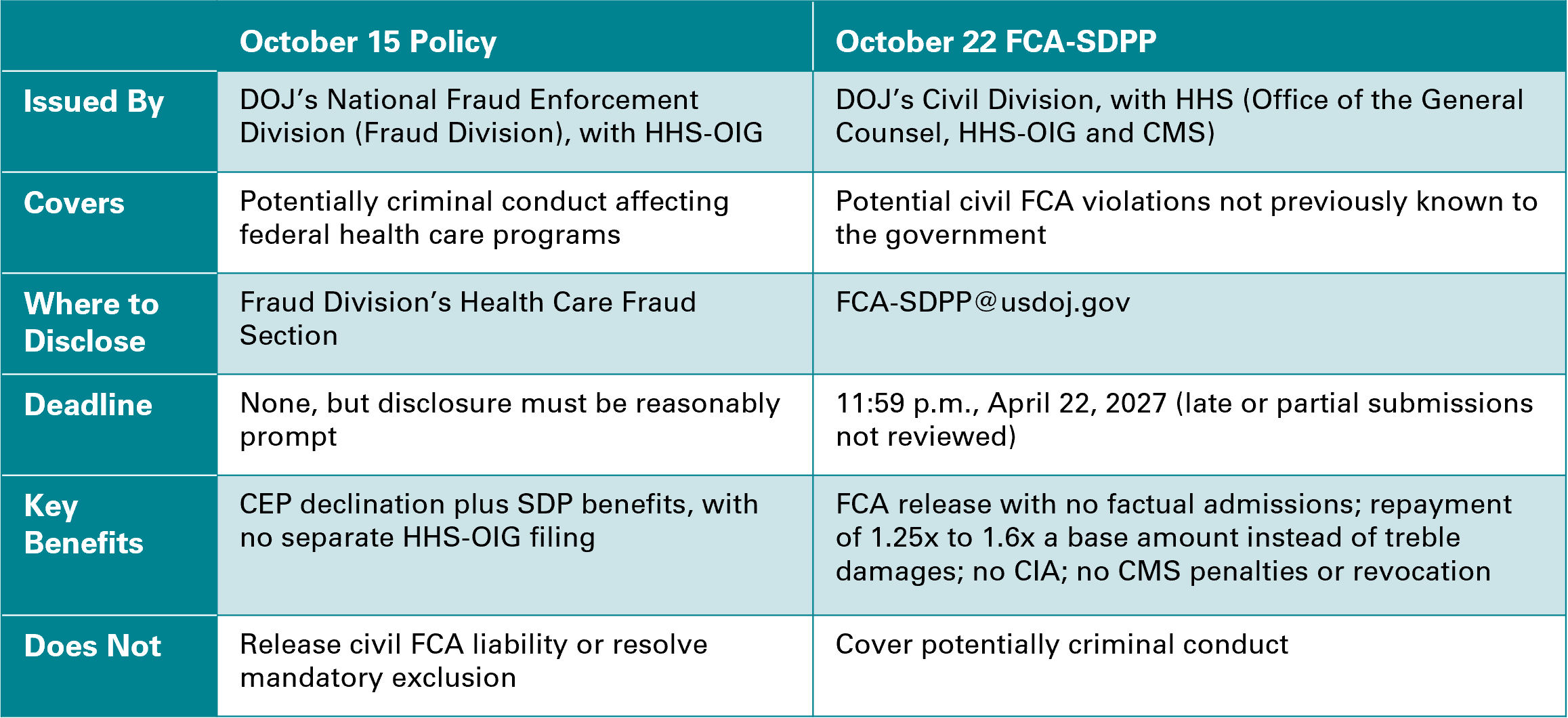
The Two Pathways at a Glance
The Details
The October 15 Policy: Potentially Criminal Conduct. One disclosure to DOJ now also secures the benefits of HHS-OIG’s SDP. A qualifying voluntary self-disclosure to the Fraud Division can earn a CEP declination. To qualify, the disclosure must be made in good faith to the appropriate DOJ component, involve misconduct not previously known to DOJ, be voluntary (not legally required), and come before an imminent threat of disclosure or investigation and within a reasonably prompt time. The discloser receives the SDP’s benefits: a speedy resolution, a lower multiplier and a release of HHS-OIG’s permissive exclusion authority without CIA obligations. DOJ forwards the disclosure to HHS-OIG, so no separate submission is required. Note that a disclosure made only to HHS-OIG generally will not qualify for a CEP declination, and HHS-OIG has to state that it is not available for federal crimes.
The October 22 FCA-SDPP: Potential Civil FCA Violations. The FCA-SDPP is open to entities paid directly or indirectly by HHS programs that desire to disclose potential civil FCA violations not previously known to the government. The disclosure must describe the conduct, attach supporting documents, describe remediation, provide financial information to calculate a Base Self-Disclosure Repayment and include an authorized representative’s certification. A qualifying disclosure provides the following benefits:
- DOJ will release the company from FCA liability with no factual admissions in exchange for repaying 1.25 to 1.6 times the base amount rather than treble damages. The multiplier depends on timeliness, the duration and scope of the misconduct, senior leadership involvement, financial benefit and successor liability with prompt remediation. For AKS violations, the government will calculate the base by reference to the remuneration and the revenue derived from the conduct, rather than the total claims paid, although the protocol does not specify how that revenue will be measured.
- This submission is in lieu of both the SDP and the SRDP. In addition, HHS-OIG will not require a CIA, and CMS will not impose CMPs or seek revocation of Medicare enrollment.
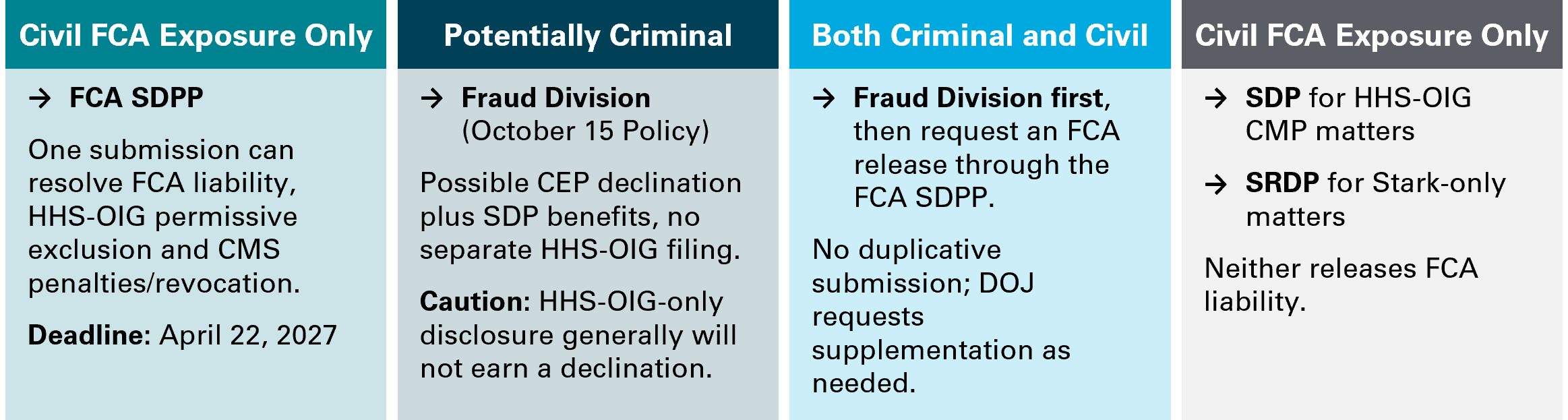
The two are linked. A company that has disclosed potentially criminal conduct to the Fraud Division need not make an FCA-SDPP submission; DOJ will request information only as needed.
A Limitation: Mandatory exclusion, which HHS-OIG must impose by statute after certain convictions, cannot be released through either pathway.
Practical Considerations: Which Route to Choose?
This decision should be discussed with counsel experienced in working with DOJ and HHS-OIG:
Manatt can help organizations determine the right self-disclosure pathway and prepare submissions. For more information on these changes, please contact , , or .
