
Published On
November 17, 2026
Authors
FTC Warns 24 Hospitals on Price Transparency: What This Means for You
While the Centers for Medicare & Medicaid Services (CMS) sets the floor for price transparency, the Federal Trade Commission (FTC) is making clear that hospitals still have obligations under federal consumer protection law.
Where Things Stand
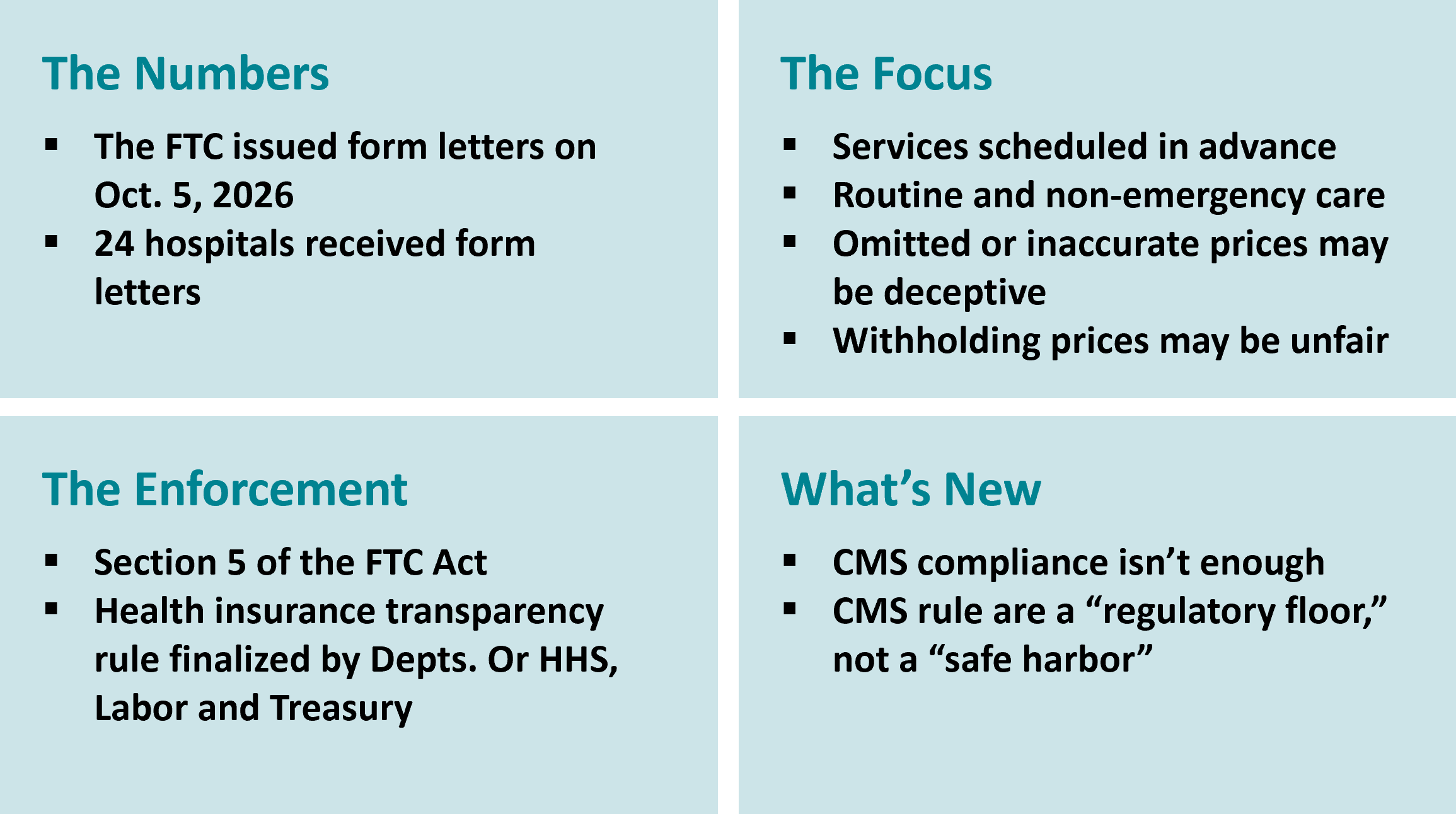
The FTC form letters to 24 hospitals emphasizing price transparency obligations under federal consumer protection law—reminding hospitals of these requirements on the same day a separate price transparency rule for health insurance was by the Departments of Health and Human Services (HHS), Labor and the Treasury.
Specifically, the FTC that “health care services companies may violate the FTC Act by failing to provide transparent price information, particularly for routine and non-emergency medical care scheduled in advance.”
At a Glance
Manatt’s Analysis
The FTC’s letters reinforced that omitting service prices or making deficient disclosures may constitute deceptive or unfair practices under the FTC Act. Health care services and the prices for them are material terms under Section 5 of the FTC Act, meaning they are likely to affect a consumer’s choice regarding the purchase of medical services.
Failure to disclose prices, or disclosing incomplete or inaccurate prices, may be deemed deceptive if the omission misleads customers. Likewise, failure to disclose prices and services may be deemed an unfair practice if it causes the consumer substantial injury and is not outweighed by benefits. The FTC stressed that price transparency enables consumers to compare their options and make informed decisions, facilitating competition in the health care market.
The FTC’s Argument
|
Also on October 5, the Departments of HHS, Labor and the Treasury finalized updated price transparency rules for group and individual health insurance coverage, which the CMS enforces. The timing suggests coordinated federal efforts to strengthen health care competition. The letters reiterated that tri-agency price transparency rules, including hospital price transparency rules, are separate from the FTC Act. The FTC specifically noted that CMS’s rules establish a “regulatory floor,” not a “safe harbor,” because “compliance with CMS requirements does not mean that a hospital has met its obligations under Section 5 of the FTC Act.”
What This Means for You
- Review Pricing Practices. Review price transparency practices and ensure they clearly and conspicuously disclose the health care services provided and the prices for them to prevent a claim that they are deceiving consumers by failing to provide timely, accurate and complete pricing information for all health care services provided to consumers. The FTC’s letter encouraged hospitals to “conduct a comprehensive review of [their] pricing practices” for compliance with the FTC’s price-transparency requirements.
- FTC Focused on Scheduled, Non-emergency Services. The letters specifically call out price transparency for services scheduled in advance: it may be unfair for a provider to withhold pricing information from consumers that the hospital should reasonably have access to in advance.
- Compliance Goes Beyond CMS. Hospitals should be mindful that compliance with CMS price transparency rules does not displace their responsibility to avoid deceptive and unfair pricing practices as enforced by the FTC.
- Expect Additional Scrutiny. While the form letters are not formal inquiries, they signal the FTC might pay closer attention to health system price transparency and could indicate future regulatory or investigatory action and potential cross-department coordination on this issue.
Talk to Manatt. Manatt’s is monitoring the FTC’s price transparency actions and can help you assess the potential impacts on your organization. Reach out to or for more. |
