
Published On
July 21, 2026
Authors
Medicaid Family Planning Programs: A Critical Coverage Pathway in the Wake of H.R. 1
Key Take-Aways
- Beginning in 2027, new work and community engagement requirements will apply to Medicaid expansion adults ages 19 through 64. It is estimated that 5.3 millionindividuals may lose coverage as a result of these requirements by 2034.
- When individuals are found ineligible under one Medicaid eligibility group, federal regulations require states to assess whether they qualify under any other Medicaid eligibility category, including family planning coverage, before terminating benefits.As a result, family planning programs may experience significant enrollment increases as individuals who lose eligibility under the expansion group transition to family planning coverage.
- Access to family planning services have worsened in the post- Dobbs period, which saw a decline in oral contraceptive use, an increase in barriers to access to contraception and fiscal and operational strain on providers that deliver the bulk of contraceptive care.
- As part of H.R. 1 implementation planning, states should act now to strengthen Medicaid family planning programs by investing in provider networks, covered benefits, eligibility and enrollment systems, and enrollee outreach to prepare for increased enrollment and preserve access to essential family planning services.
- Strengthening family planning programs complements implementation of broader maternal health policies, such as extending Medicaid’s postpartum period to 12 months and addressing maternal health through Rural Health Transformation efforts.
Why Medicaid Family Planning Programs Are Even More Important When H.R. 1 Goes Into Effect
As states prepare to implement H.R. 1, much of the policy and operational discussions have focused on the millions of individuals expected to lose Medicaid coverage as the result of new work requirements and more frequent eligibility redeterminations. The Congressional Budget Office has estimated that 5.3 million individuals could become uninsured as a result of Medicaid work requirements by 2034, with about half of those coverage losses stemming from paperwork and process challenges instead of actual ineligibility.A recent CMS will make implementation of work requirements even more difficult and more likely to trigger additional coverage losses among eligible people.
However, far less attention has been paid to what happens after people lose full Medicaid coverage. In states that have both expanded Medicaid and implemented Medicaid family planning programs, those programs will become an increasingly important source of coverage for individuals who lose eligibility under the Medicaid expansion group. For many, they may represent the only remaining source of health care coverage, ensuring continued access to essential family planning and reproductive health care services. Federal Medicaid regulations require states to assess individuals losing Medicaid eligibility for all other available eligibility categories, including family planning programs, before terminating coverage.The 28 states that operate Medicaid or state-funded family planning programsand have adopted Medicaid expansion (or waiver-like Medicaid expansion programs)could see significant enrollment increases in these programs starting in 2027 as the expansion population begins losing full Medicaid coverage. States should act now to ensure their family planning programs, and the providers that operate within those programs, are equipped to handle increased enrollment and enhance access to family planning program services.
States with Family Planning Programs Impacted By H.R.1 Work and Community Engagement Requirements
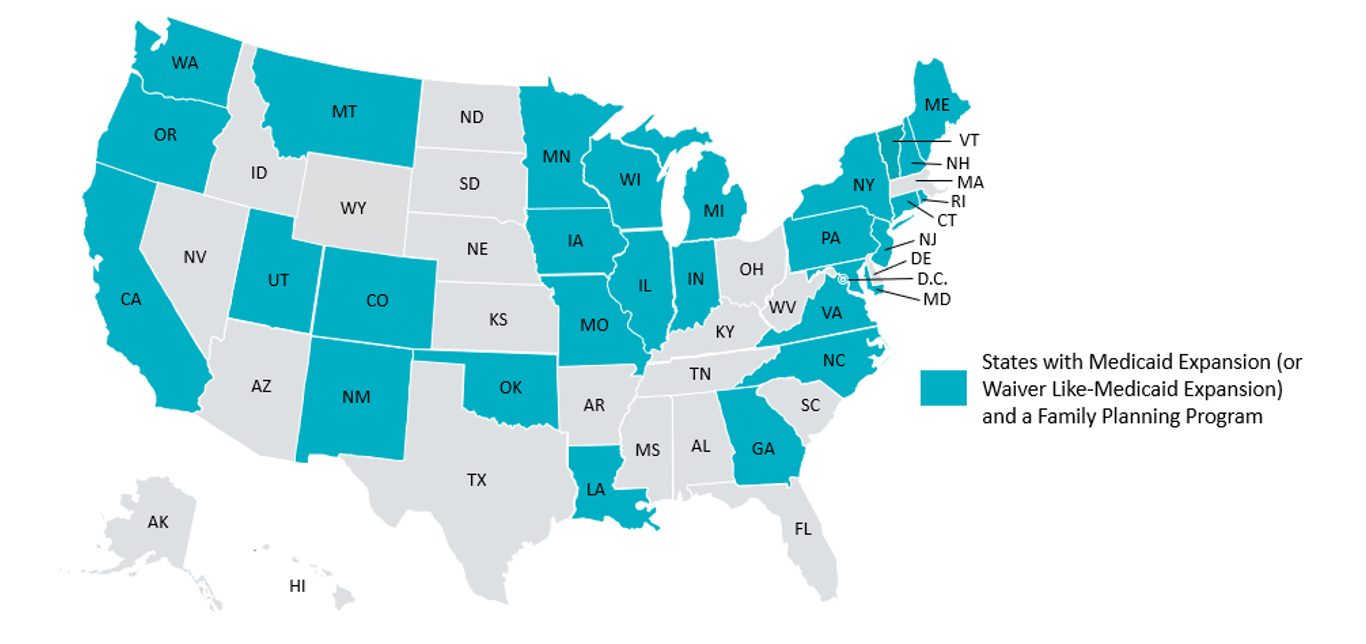
Source: Manatt analysis; KFF, and KFF,
What States Should Be Doing Right Now
As part of H.R. 1 implementation, states should be folding in policy and operational planning to strengthen their Medicaid family planning programs. This is especially important given persistent and growing access challenges to family planning services. While more than 82% of women use contraception, only one-third of low-income women receive family planning services and 19 million people live in contraceptive deserts that lack reasonable access to a health center that offers the full range of contraceptive methods. Access challenges have worsened in the post-Dobbs environment, with significant declines in oral contraceptive and emergency contraceptive use following the Supreme Court's decision, underscoring the need for states to invest in family planning coverage and provider capacity now.
By adopting best practices in the key areas below, states can address reproductive health access challenges and ensure that eligible individuals do not fall through coverage gaps and continue to receive high-quality, critical family planning services and supports, even if they lose full Medicaid coverage:
- Strengthen Provider Access. States should strengthen provider networks by monitoring enrollee access to family planning providers, including assessing the number and geographic location of family planning providers and maintaining accurate provider directories that are accessible to enrollees on state websites. States should also ensure that family planning services can be delivered via telehealth so that individuals with transportation barriers or those that live in rural areas can still access services.
- Ensure Adequate Reimbursement Rates. States should take advantage of the 90% match for Medicaid family planning services to align provider reimbursement rates to be commensurate with primary care services, ensure telehealth visits are reimbursed at the same rate as in-person visits, support care navigation and care coordination services through a care management fee or other enhanced payment, and consider quality payments for meeting state goals.
- Evaluate Suite of Covered Services. States should evaluate whether their family planning benefit package supports meaningful access to reproductive health care, including coverage of all FDA-approved contraceptive methods and family planning-related services. This includes treatment of medical conditions routinely diagnosed during a family planning visit (e.g., urinary tract infection, sexually transmitted infections), preventive services routinely provided during a family planning visit (e.g., HPV vaccine) and treatment of a major medical complication resulting from a family planning visit. Where gaps exist, States should work now to address them.
- Validate Eligibility and Enrollment Logic Flows. States should review eligibility system logic, redetermination workflows, and operational processes to ensure that individuals losing Medicaid expansion coverage are automatically evaluated for and enrolled in family planning coverage before disenrollment.
- Educate Enrollees On Coverage Options. States should develop clear enrollee-facing materials explaining that family planning coverage may remain available even if they lose full Medicaid coverage. These materials should be on state websites, included in onboarding materials, and be a component of any state-based eligibility worker trainings to educate enrollees about which services are covered and reinforce they have free choice of any family planning provider.
For more information on these and other best practices, see this Manatt on Implementing State-Level Processes That Enhance Access to Medicaid Family Planning Program Services.
Looking Ahead
Medicaid family planning programs have long been an underutilized and often overlooked coverage pathway. In the wake of H.R. 1, however, they will become a critical coverage vehicle for individuals who lose full Medicaid eligibility but remain eligible for family planning services. For many, these programs will be the only remaining source of health coverage, ensuring continued access to essential family planning and reproductive health services. States that invest now in strengthening their Medicaid family planning programs—including provider networks, covered benefits, eligibility and enrollment systems, and consumer outreach—will be better positioned to preserve access to care as large numbers of individuals begin losing full Medicaid coverage over the coming months.
Congressional Budget Office. (2025, October 28). Supplemental cost estimate for Public Law 119-21: To provide for reconciliation pursuant to Title II of H. Con. Res. 14, Title VII, Finance, Subtitle B, Health, Chapter 1, Medicaid.
Under the CMS Interim Final Rule on Community Engagement Requirement for Certain Individuals, Manatt Health coverage loss could be upwards of 9.2 million people who lose coverage by 2034.
Code of Federal Regulations, 42 C.F.R. § 435.916(d).
Qato, D. M., Myerson, R., Shooshtari, A., Guadamuz, J. S., & Alexander, G. C. (2024). Use of oral and emergency contraceptives after the U.S. Supreme Court's Dobbs decision. JAMA Network Open, 7(6), e2418620.
Congressional Budget Office. (2025, October 28). Supplemental cost estimate for Public Law 119-21: To provide for reconciliation pursuant to Title II of H. Con. Res. 14, Title VII, Finance, Subtitle B, Health, Chapter 1, Medicaid.
Manatt Health. 2026. “CMS Releases Interim Final Rule on Medicaid Work Reporting Requirements.” June 15, 2026. .
Under the CMS Interim Final Rule on Community Engagement Requirement for Certain Individuals, Manatt Health coverage loss could be upwards of 9.2 million people who lose coverage by 2034.
Code of Federal Regulations, 42 C.F.R. § 435.916(d).
KFF. (2025). States that have expanded eligibility for coverage of family planning services under Medicaid. KFF State Health Facts.
KFF. (2025). Medicaid expansion enrollment. KFF State Health Facts.
Frederiksen, B., Diep, K., & Salganicoff, A. (2024, November). Contraceptive experiences, coverage, and preferences: Findings from the 2024 KFF Women's Health Survey. KFF.
Martinez, G. (2024). Receipt of family planning services in the United States: 2022–2023 (NCHS Data Brief No. 520). National Center for Health Statistics.
Power to Decide. (2025). Contraceptive deserts 2025.
Qato, D. M., Myerson, R., Shooshtari, A., Guadamuz, J. S., & Alexander, G. C. (2024). Use of oral and emergency contraceptives after the U.S. Supreme Court's Dobbs decision. JAMA Network Open, 7(6), e2418620.
Centers for Medicare & Medicaid Services. (2016, June 14). Medicaid family planning services and supplies (State Health Official Letter No. 16-008). U.S. Department of Health and Human Services.
