Published On
November 12, 2026
Authors
The Most Wide-Reaching CPOM Bill Yet: What It Means for You
Manatt’s Take
This is the most restrictive federal corporate-practice-of-medicine bill introduced to date. The proposed Act builds on recent state-level efforts and is the first attempt at a nationwide ban on corporate ownership of physician groups. Passage this session is unlikely, but the bill’s scope (reaching ownership, MSO contracts, non-competes, and enforcement all at once) signals that federal and state lawmakers are serious about cracking down on corporate ownership and indirect control of physician practices. Physician practices, MSOs, and investors should evaluate their current structures now to assess compliance with existing laws, as well as those being proposed at the federal and state levels.
What the Bill Would Do
The bill would establish the first federal prohibition on the corporate practice of medicine, restricting corporate ownership of medical practices, limiting MSO authority over physician practices and protecting clinicians from corporate interference. It is directly modeled on Oregon’s SB 951.
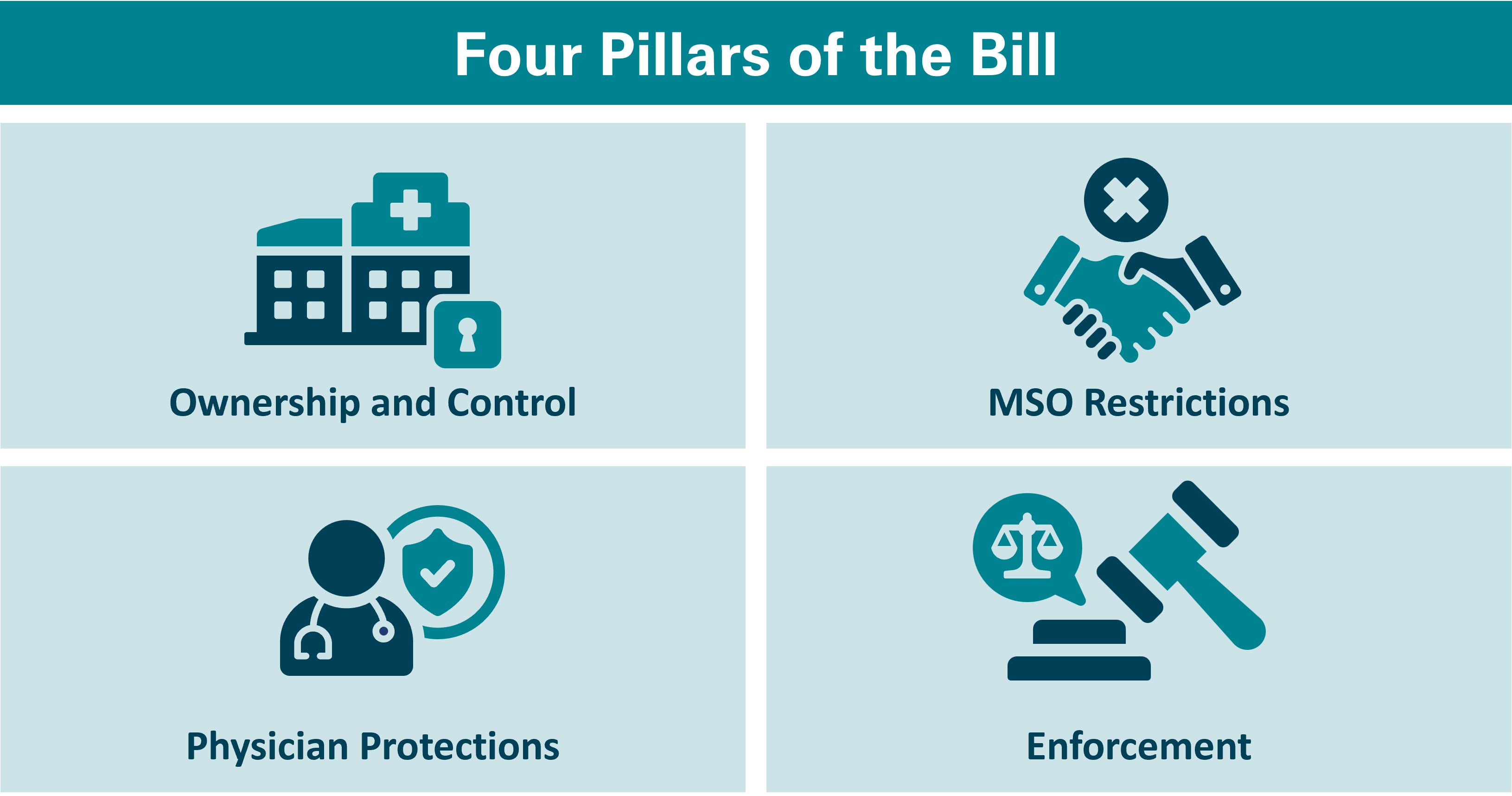
1. Ownership & Control of Medical Practices
- A partnership or corporate entity may not own or control a medical practice, employ or contract for a licensee’s professional services, or otherwise practice medicine unless majority-owned and controlled by licensees.
- Licensee owners must be licensed and present in the state where the practice furnishes patient services, and substantially engaged in delivering care.
- Multistate MSO/PC structures and virtual care models face the greatest exposure because the requirement for physician owners to be present where patients are treated could limit expansion and complicate virtual care arrangements where patients and providers are often in different states.
2. Restrictions on Management Services Organizations
- MSOs would be barred from financing or having ownership interests in a medical practice, paying dividends from a practice’s ownership interests, or restricting transfer of a practice’s ownership interests or assets.
- MSOs would not exercise de facto control over care-affecting decisions, including personnel, clinician schedules and compensation, billing and pricing, or payor contracting, and could not advertise a practice’s services under another entity’s name. These prohibitions squarely target “friendly physician” structures commonly relied upon.
- Management services agreements (and any amendment, renewal, or termination) would need to be negotiated at arm’s length, with the practice independently selecting its own counsel and compensation set at fair market value as determined by the FTC.
- MSOs, and their owners, employees, and affiliates, could not advertise a medical practice’s services under any name other than the practice’s own.
- Agreements granting prohibited MSO authority would be void and unenforceable.
3. Protections for Physicians and Other Licensed Professionals
- Health care providers (the professional entity) could not use discipline, retaliation, or similar pressure to interfere with a clinician’s professional judgment, including admission decisions, treatment timing, or discharge referrals.
- Noncompete, nondisclosure, and non-disparagement agreements involving licensees, health care providers, and MSOs would generally be prohibited and unenforceable.
4. Enforcement and Private Rights of Action
- The FTC would enforce the law and violations would be treated as unfair or deceptive acts or practices.
- An injured person could sue for damages and other relief; state attorneys general could separately sue on behalf of residents.
- Remedies: courts would be required to issue injunctions and, where applicable, order divestiture and disgorgement of revenue earned during the violation period.
- Program exclusion: violations would also become a basis for exclusion from federal health care programs.
What This Means for You
This bill would become effective one year after enactment (if passed). The bill does not provide a transition period for existing arrangements and goes further than most state laws. Even if it does not pass, more states may adopt similar restrictions, so physician practices, MSOs, and investors should consider whether their current structures would comply.
If you operate or invest in an MSO/PC structure
- Evaluate whether existing arrangements comply in operation, not just on paper—the bill looks at how authority over a practice is actually exercised, not just how it’s documented.
- Review management services agreements against the bill’s requirements, including whether the practice selected its own independent counsel, whether the terms reflect an actual negotiation rather than a template set by the MSO or investor, and whether the fees are supported by an independent fair market value analysis. Agreements that fall short should be revisited, and any future amendment or renewal should follow the same process.
If you run a multistate or virtual care model
- Assess physician-owner presence requirements against your current state footprint because the bill would require owners to be licensed and substantially engaged where patients are treated.
- Develop a strategy for virtual care.
If you rely on noncompete, nondisclosure, or non-disparagement terms
- Revisit these provisions in physician and MSO agreements because the bill would render them generally unenforceable.
For everyone in this space
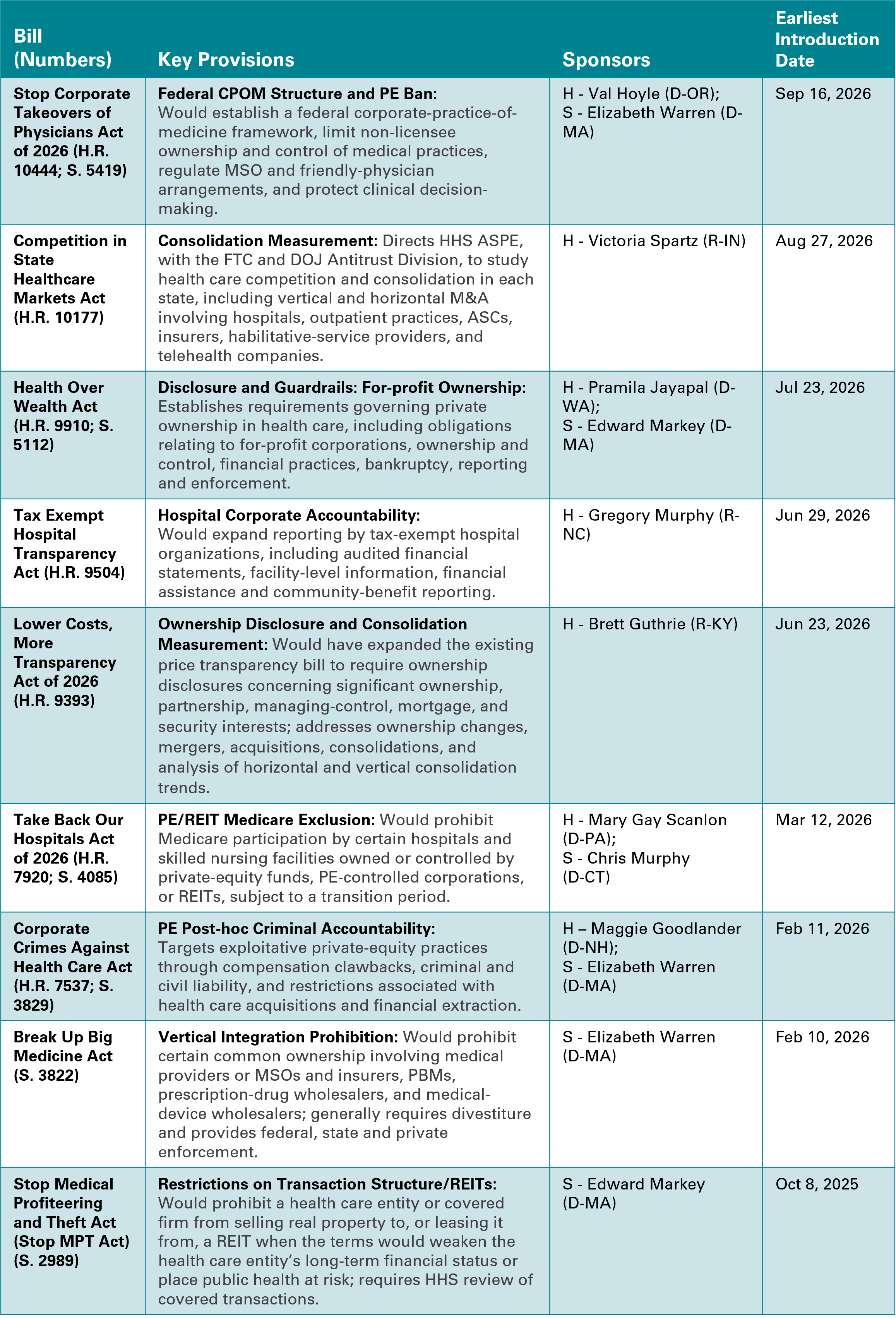
- Continue monitoring federal and state developments—this bill is one of at least ten CPOM-related bills now in play (listed below).
- Engage in advocacy early to educate federal and state lawmakers on how the bill would affect patient access and existing care models. This is especially important for virtual care providers, whose multistate operations would be significantly disrupted by the bill’s ownership and in-state presence requirements.
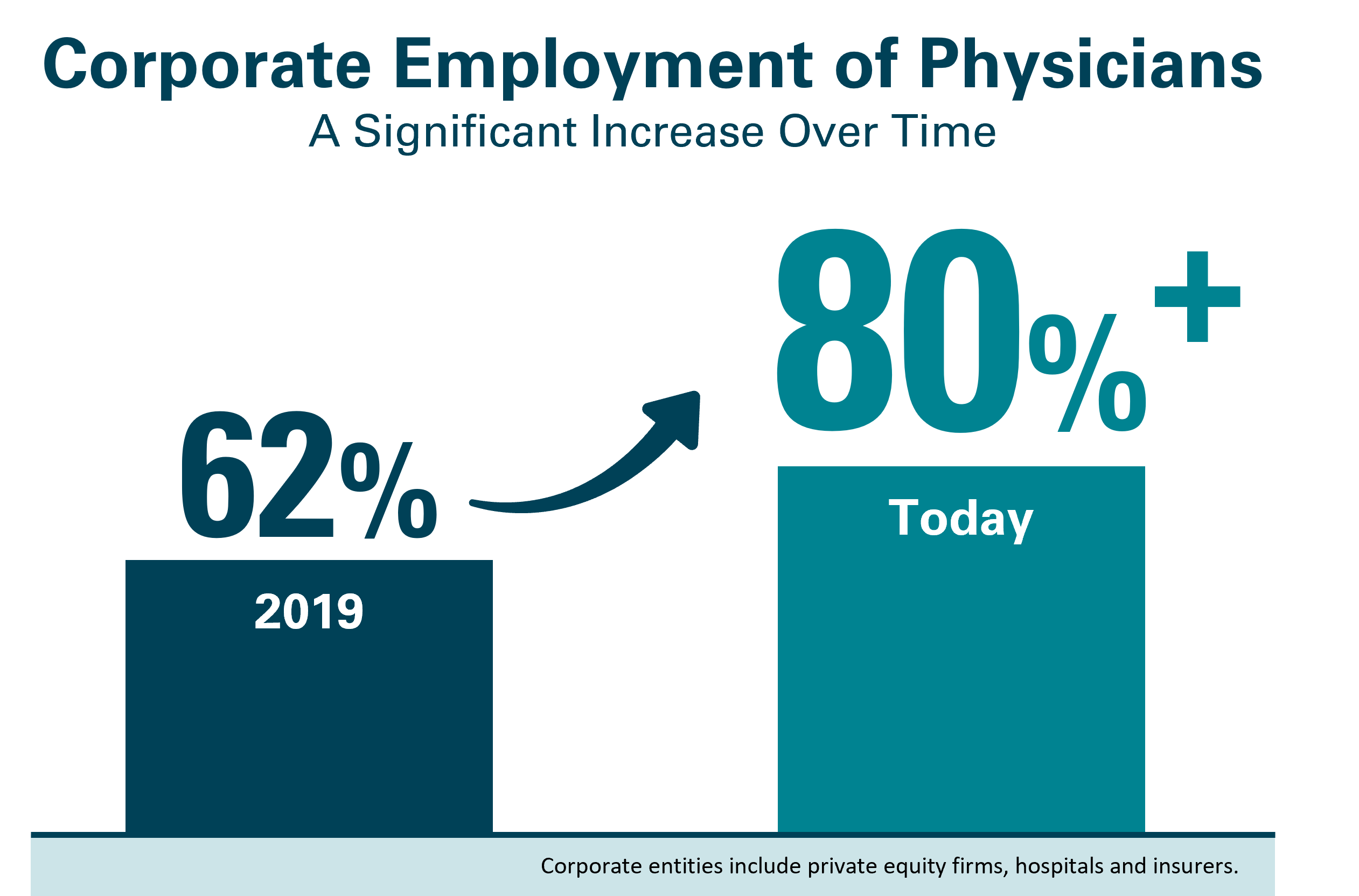
Lawmakers cite a growing trend in physician consolidation as a rationale for this bill, pointing to survey data showing that more than 80% of physicians are now employed by corporate entities—including private equity firms, hospitals, and insurers—compared with 62% in 2019. Worth noting for context: that survey includes hospital-employed physicians, whom the bill would exempt, and 61% of respondents reported working in inpatient or outpatient hospital settings.
Looking Ahead
H.R. 10444 is unlikely to advance before the end of the current session, but it reflects continued, intensifying scrutiny of corporate involvement in physician practices—and it takes a more restrictive approach than most federal or state efforts to date.
Manatt has been closely tracking federal and state activity in this space over the past year and will publish a year-end roundup on the evolving corporate-practice-of-medicine landscape. In the meantime, physician practices, MSOs, and investors should keep evaluating whether their existing arrangements would hold up to this level of scrutiny. Given Democratic control of both chambers following the midterm elections, proposals addressing corporate ownership and control of health care entities are more likely to receive further consideration in the upcoming legislative session.
Related Bills Introduced in the 119 Congress