
Published On
November 3, 2026
Authors
California Antitrust Law Now Outlaws Monopolization
California has expanded its antitrust law to cover monopolization and monopsonization by individual firms, giving state enforcement authorities a new tool to challenge single-firm conduct beginning January 1, 2027.
Why It Matters
Companies with significant market positions or substantial operations in California should evaluate whether their pricing, distribution, exclusivity, procurement and workforce practices could face additional scrutiny under the new law. Importantly, businesses should not assume that conduct permissible under federal monopolization precedent will necessarily receive the same treatment under California law.
COMPETE Act at a Glance
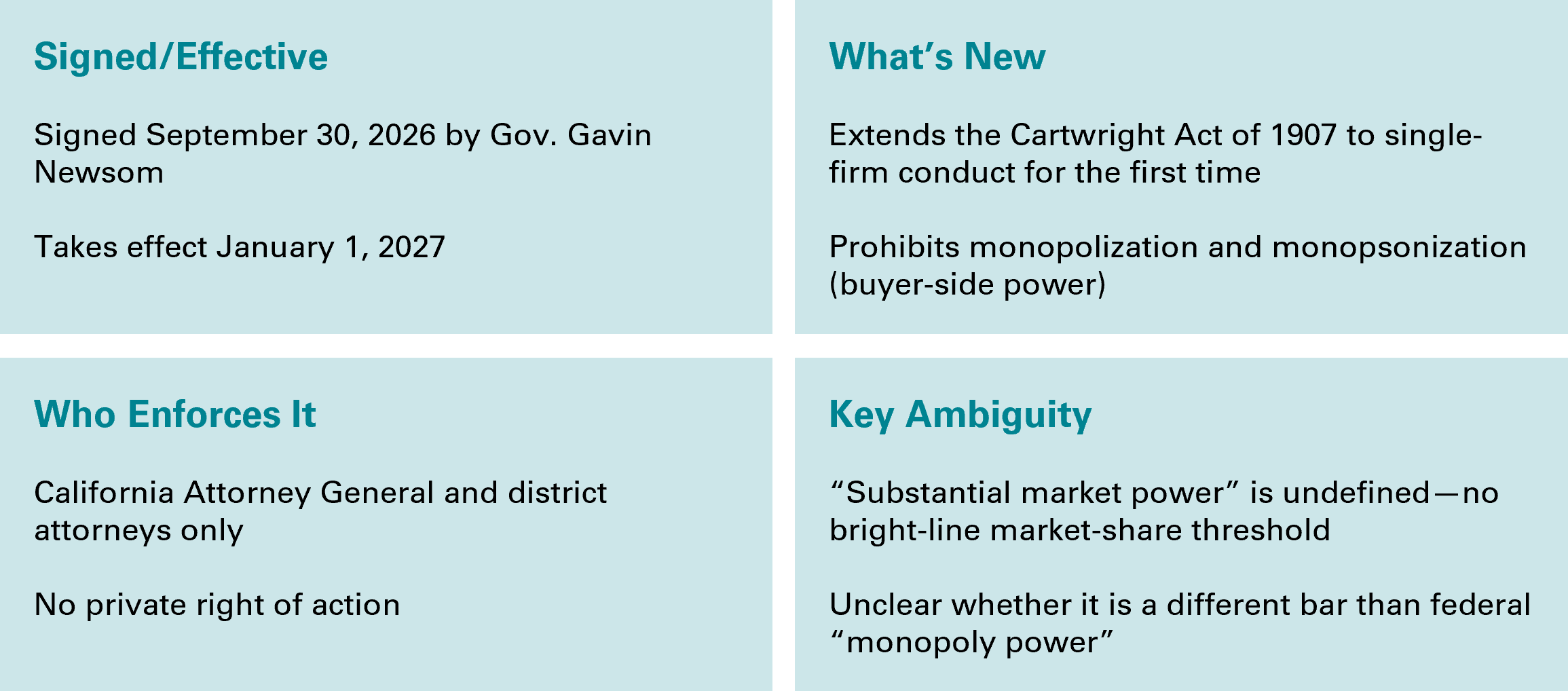
What Changed
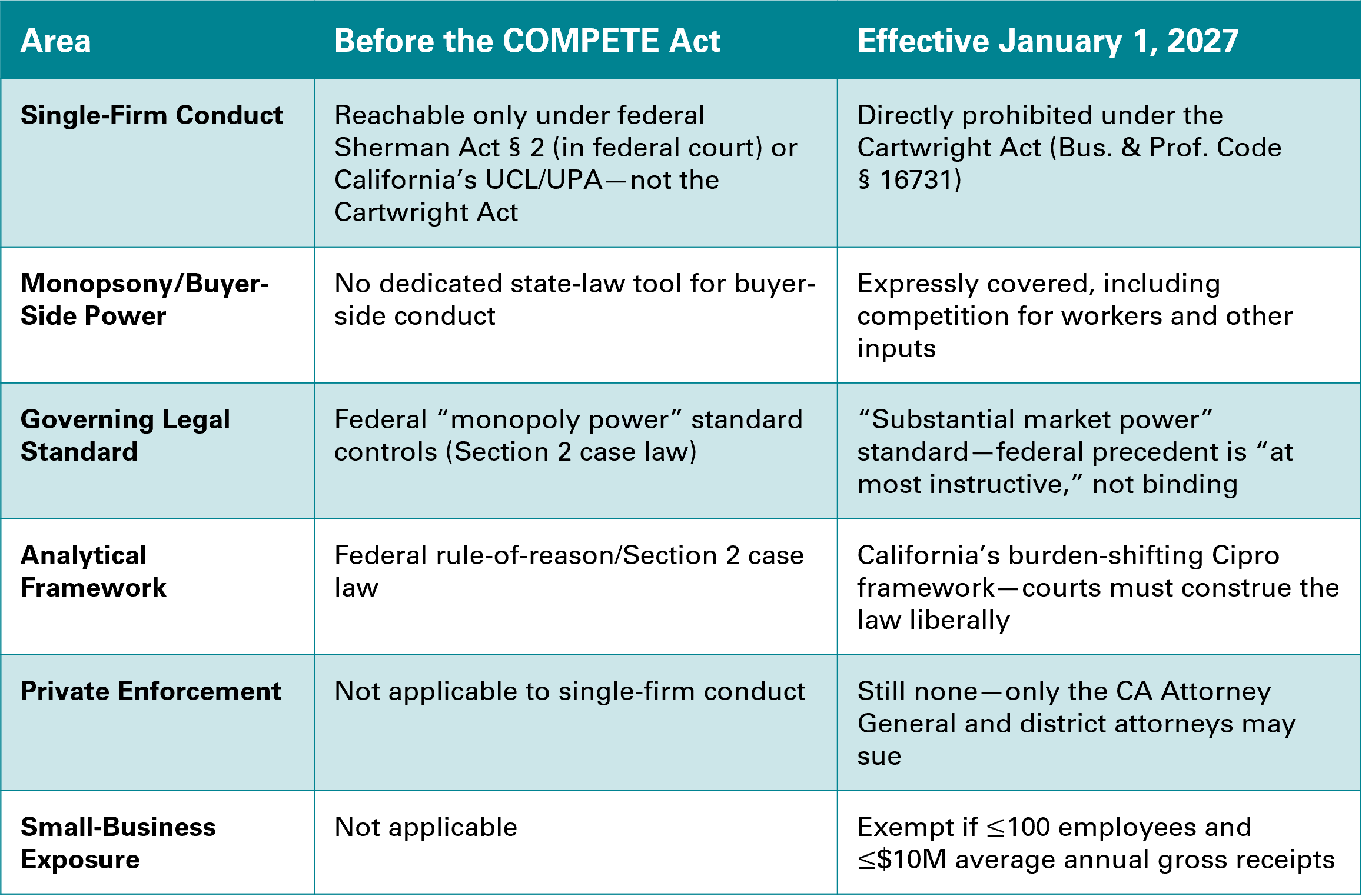
The Competition and Opportunity in Markets for a Prosperous, Equitable and Transparent Economy (COMPETE) Act, formally Assembly Bill 1776, amends Section 16731 of the Business and Professions Code. The table below summarizes the most consequential shifts.
Manatt’s Analysis
Since 1907, the Cartwright Act has reached only multi-firm conduct. Single-firm conduct could be challenged only under federal Section 2 or California’s UCL/UPA. The COMPETE Act closes that gap.
The enacted version, however, is considerably narrower than as originally proposed. What remains is a direct prohibition on monopolizing that is enforceable only by the Attorney General and district attorneys.
The central open question—and the one that will likely define early enforcement—is whether “substantial market power” is a lower bar than the “monopoly power” standard under federal law.
Governor Newsom’s own signing message acknowledged courts will “necessarily grapple” with the term and signaled that follow-on legislation may ultimately be needed.
Until that question is resolved, companies should treat their federal antitrust compliance posture as necessary but not sufficient in California.
What Companies Should Do Now
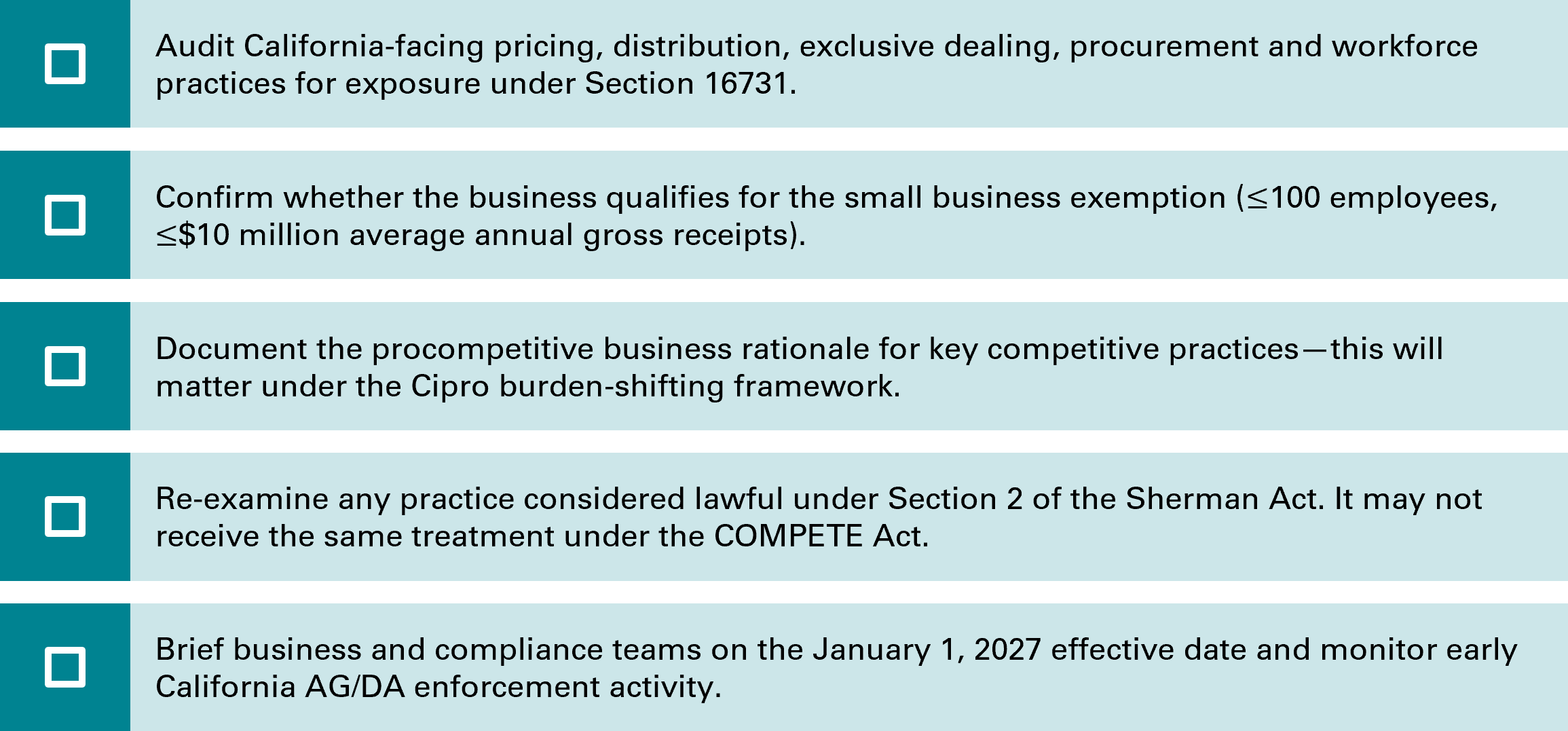
- Companies should review pricing, distribution, exclusive dealing, procurement and labor practices for potential exposure in California before January 1, 2027.
- Do not assume that conduct lawful under Section 2 of the Sherman Act will be treated the same way under the COMPETE Act by California antitrust enforcers.
- Companies should document the business rationale for key competitive practices. This will matter under the Cipro framework.
Pre-January 1 checklist:
Organizations Most Likely to Be Impacted
Based on the Act’s scope, organizations that meet any of the following are more likely to face scrutiny:
Monopolization exposure (seller-side)
- Hold a leading or dominant share in any California product or service market, particularly where that position has been defended on federal Section 2 grounds rather than tested against a “substantial market power” standard
- Rely on exclusive dealing, tying, bundling, refusal-to-deal or predatory pricing practices
Monopsonization exposure (buyer-side)
- Exercise significant buyer-side concentration in a California supply, input or procurement market
- Compete for talent in ways that could be characterized as suppressing wages or mobility (e.g., no-poach arrangements, aggressive non-competes, coordinated hiring practices)
Multi-party conduct
- Participate in joint ventures, partnerships or coordinated arrangements with a firm with substantial market power that could be recast as combining or conspiring to monopolize rather than as purely unilateral conduct
Structural / exemption screen
- Exceed the small business exemption thresholds (more than 100 employees or more than $10 million in average annual gross receipts) and do not operate under a government-supervised exclusive franchise, contract, license or permit
Enforcement-priority factor
- Operate in sectors where the California Attorney General or district attorneys have signaled active antitrust interest (e.g., technology, health care, agriculture, energy or labor markets)—these companies are more likely to be selected for early test cases, independent of pure legal exposure
Talk to Manatt. Manatt's is monitoring implementation of the COMPETE ACT and can help you assess its impact or perform a readiness review.
