
Published On
April 9, 2026
Authors
Five Trends for Health Investors to Watch in 2026
As the first quarter of 2026 ends, the growth equity and buy-out investment community is coalescing around a handful of common themes, consistent with feedback we received in January at the J.P. Morgan Healthcare Conference. Below, we outline the five key trends our health care M&A advisory team is tracking.
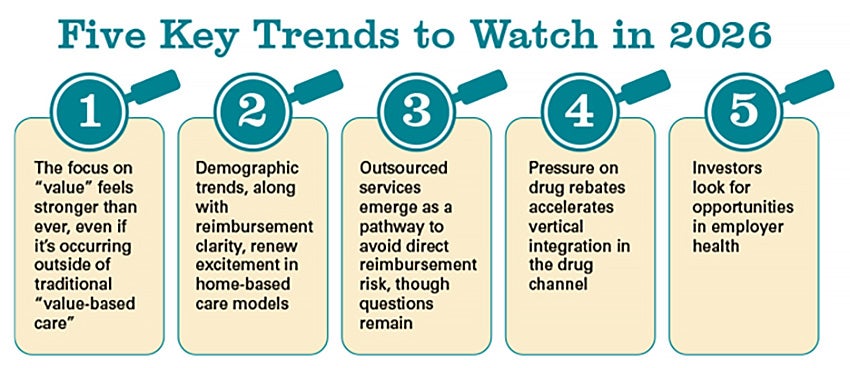
1. The focus on “value” feels stronger than ever, even if it’s occurring outside of traditional “value-based care”
2026 has already proven to be an active year of new value-based care model testing out of the CMS Innovation Center (CMMI), but from our assessment of deal activity and investor sentiment, it appears that as much (if not more) focus will fall on opportunities to define a very near-term return-on-investment. We’re monitoring renewed interest in site-of-care optimization, care coordination/care management and other models where the speed to value is accelerated. That doesn’t discount the very real potential from CMMI’s contemplated changes under ACO LEAD or the ACCESS model, but rather serves as a reflection on investor wariness related to long timelines for adjudicating value.
2. Demographic trends, along with reimbursement clarity, renew excitement in home-based care models
After a volatile few years, we’re observing durable interest in home-based care models—whether that’s within the confines of primary care delivered into the home or skilled/unskilled home health models or hospice/palliative care. We expect some of this is the result of emerging regulatory clarity: for home-based primary care, that means clarity in life after ACO REACH via expanded participation opportunities in ACO LEAD; for skilled home health, that means clarity in reimbursement as Patient-Driven Grouping Models (PDGM) implementation runs its course. Within Medicaid, we expect the renewed interest in home- and community-based services is in part a reflection on trend #1 above: investors see home- and community-based settings as critical to bending the cost-curve for high cost, high complexity patient categories like individuals requiring long-term services and support. While this Administration has renewed its focus on compliance and reducing fraud, waste and abuse within the sector (particularly in hospice and personal care services), additional scrutiny actually plays to strengths of scaled players, who are more likely to be the targets of interest for institutional capital.
3. Outsourced services emerge as a pathway to avoid direct reimbursement risk, though questions remain
Building on the theme of diversifying definitions of value, we’re observing that investors with deep experience backing provider/service organizations are focusing in on tech-enabled and outsourced service models as the next wave, with artificial intelligence serving as a generational catalyst for model efficiency. This trend is perhaps best exemplified by the momentum behind revenue cycle management, but broadly, we’re seeing excitement around the ability of tech-enabled solutions to meaningfully reduce the administrative burden on payor/provider/patient interaction with the health care system. The core challenge ahead for investors is two-fold: (1) how best to underwrite the pace of adoption, and (2) how meaningful will the efficiency gains from artificial intelligence be in the near-term. These challenges are likely to elongate transaction timelines, but we view interest in the sector as durable.
4. Pressure on drug rebates accelerates vertical integration in the drug channel
It’s hard to understate the amount of change in the drug pricing discourse over the last 12 to 18 months. Recent legislative reforms targeting pharmacy benefit manager (PBM) business practices across multiple insurance lines of business have promoted a gradual shift away from overreliance upon negotiated rebates as a core profit center and toward control of the value chain (buy-and-bill heavy provider practices, specialty pharmacies and biosimilar white labeling among them). As loss of exclusivity events combine with the implementation of Medicare Negotiation to drive topline pricing and reimbursement pressure on legacy blockbuster products, pharmacies with limited distribution drug portfolios and/or the scale to optimize their acquisition cost will be better positioned to defend value over the near- to medium-term.
5. Investors look for opportunities in employer health
With the backdrop of another year of nearly double-digit cost growth, employers and the benefit consultants are at a tipping point. These market trends, combined with a highly fragmented solution market, have piqued growth equity and buy-out investor interest in the opportunity to build scaled, diversified partners of choice for the employer community. It’s unclear whether we’ll see meaningful actionable opportunities in the sector in the near-term, particularly for private equity, but real scale and momentum are emerging in the third-party administrator, care navigation, PBM and specialty network management sectors.
