
Published On
July 1, 2026
Authors
Integrating AI and Telehealth: Remote Patient Monitoring
Rural and medically underserved regions nationally face higher rates of chronic disease and related mortality, exacerbated by workforce shortages that limit access to specialty care and can lead to fragmented longitudinal care. Remote patient monitoring, including remote physiological monitoring (RPM) and remote therapeutic monitoring (RTM), has emerged as a care model that can address access concerns by extending clinical oversight between visits through biometric monitoring and tracking of patient-reported outcomes, and supporting provider clinical decision-making beyond what is feasible through direct in-person or virtual encounters alone. This care model is being utilized across a range of patient populations and clinical settings, including primary care, specialty care, and post-acute transitions, with the potential to reduce avoidable health care utilization and downstream costs. Although utilization of RPM and RTM has grown, largely driven by an improved coverage and reimbursement landscape, challenges to widescale adoption remain, including limited patient engagement, variability in coverage across payers and states that creates financial uncertainty for providers, and operational complexity that may limit program scalability.
As artificial intelligence (AI) technology matures, its integration into RPM and RTM programs may support broader adoption by addressing workflow challenges, improving clinical impact, and strengthening financial return on investment of monitoring services. AI can streamline burdensome administrative processes for care teams and support providers in targeting RPM and RTM resources toward the patients and conditions where monitoring has demonstrated the most clinical benefit, helping build the evidence base for effective use and reinforcing the case for broader payer adoption.
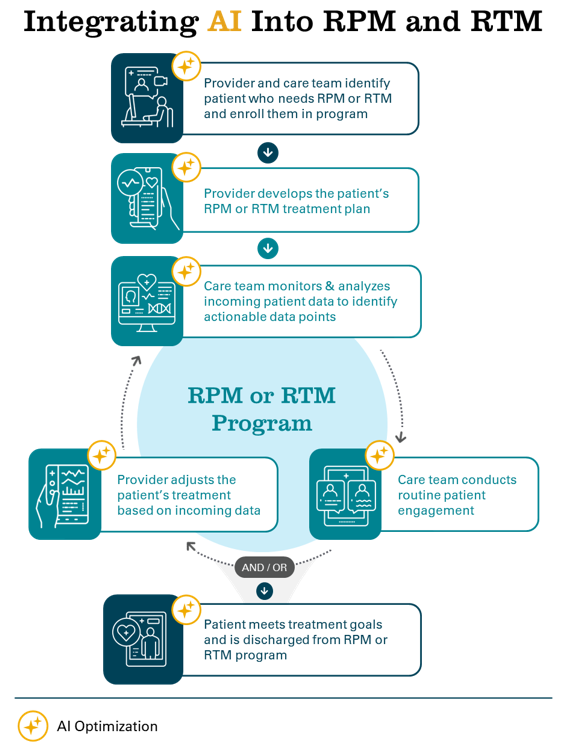
This was developed by Manatt Health and the Telehealth Centers of Excellence at the Medical University of South Carolina (MUSC) and the University of Mississippi Medical Center (UMMC) as part of a collaboration to identify and describe opportunities to integrate AI within telehealth programs to support broader telehealth scaling and adoption. This brief is part of a series of four briefs, each focused on a different telehealth use case and based on background research and expert interviews with health system and telehealth vendor leaders.
Read the full report . A prior report on the integration of AI into electronic Consults can also be found .
Rural Health Information Hub. Chronic Disease in Rural America.
Mahajan, A., Heydari, K. & Powell, D. Wearable AI to enhance patient safety and clinical decision-making. npj Digit. Med. 8, 176 (2025).
