
Published On
August 11, 2026
Authors
Maternity Care Unbundled: What Stakeholders Should Prepare for Ahead of January 1, 2027
In September 2025, the American Medical Association (AMA)’s Current Procedural Terminology (CPT) Editorial Panel advanced a significant restructuring of maternity care coding, moving away from decades-old global maternity codes toward an “unbundled” framework that allows providers to bill for discrete services delivered across the prenatal, delivery and postpartum continuum and more closely reflect how care is delivered today. Payors and states will observe maternity care through a series of service-level claims rather than a single retrospective bill, enabling more detailed analysis of utilization, quality and equity but requiring substantially different operational and analytic infrastructure.
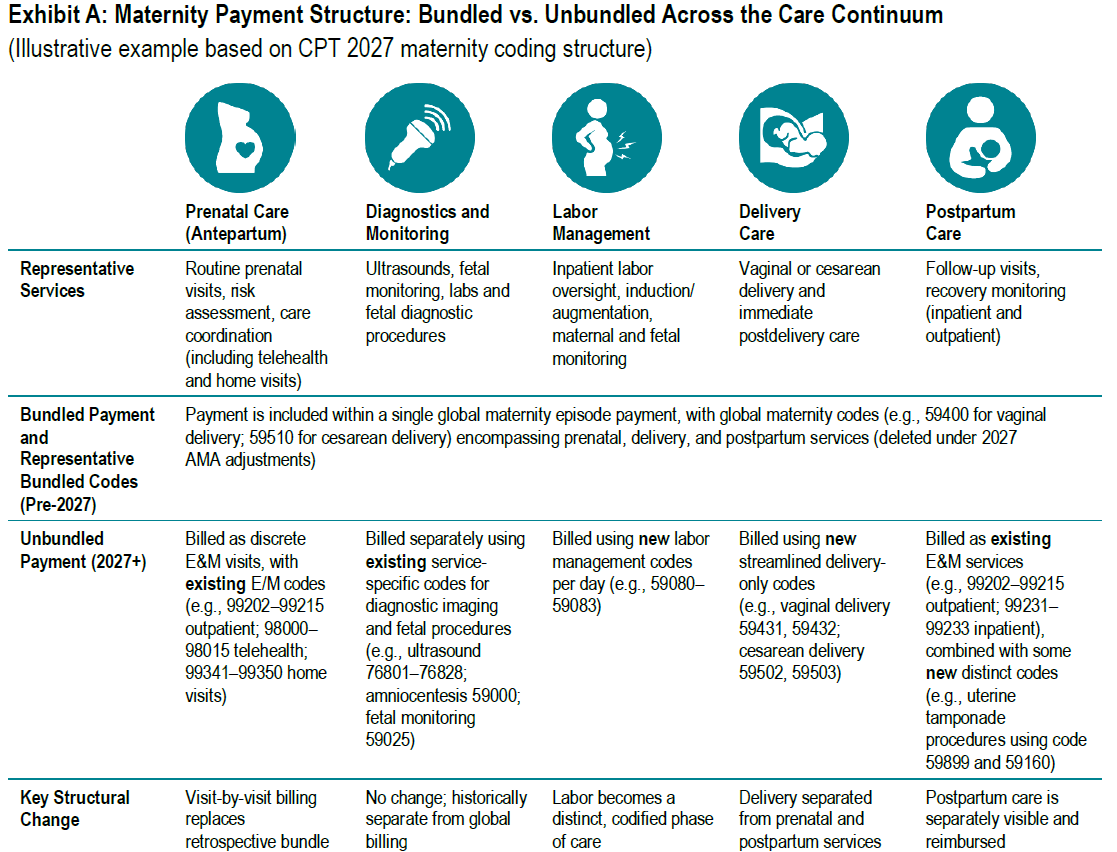
Under the updated 2027 CPT guidelines, the restructured code set is a combination of existing codes—including evaluation and management (E/M) codes for antepartum and postpartum care and separately reportable diagnostic imaging/procedural codes—and new maternity-specific codes, particularly for labor management, streamlined delivery reporting and select delivery/postpartum procedures. In total, the CPT 2027 update deletes 17 codes, adds 12 codes and revises six codes. The introduction of separately billable, labor management codes, billed on a per-day basis and differentiated by clinical complexity, represents one of the most significant elements of the redesign, shifting reimbursement toward the intensity and duration of care provided during labor.
This change represents the most consequential shift in maternal health payment policy since maternity codes were bundled in the 1980s. It comes amid persistently poor and, in some cases, worsening maternal and infant health outcomes, widening racial and geographic disparities and the continued growth of maternal health deserts. This has occurred alongside growing recognition that existing payment structures have not kept pace with how maternity care is delivered today, often undervaluing community-based models and care that emphasizes prevention, coordination and higher-acuity needs.
The AMA has modeled the unbundling as budget-neutral nationally; however, neutrality at a national level does not guarantee neutrality for individual states, health plans or provider systems. For example, entities serving higher-acuity or more medically complex maternal populations may experience higher utilization and spending, while those with lower-risk populations could see more modest or even reduced spending. The more immediate challenge for states, plans and providers is making near-term operational and policy decisions with incomplete information, particularly during the 2026–2027 transition period, which will introduce complexity for patients spanning both coding structures.
Key Milestones Over the Next Six Months
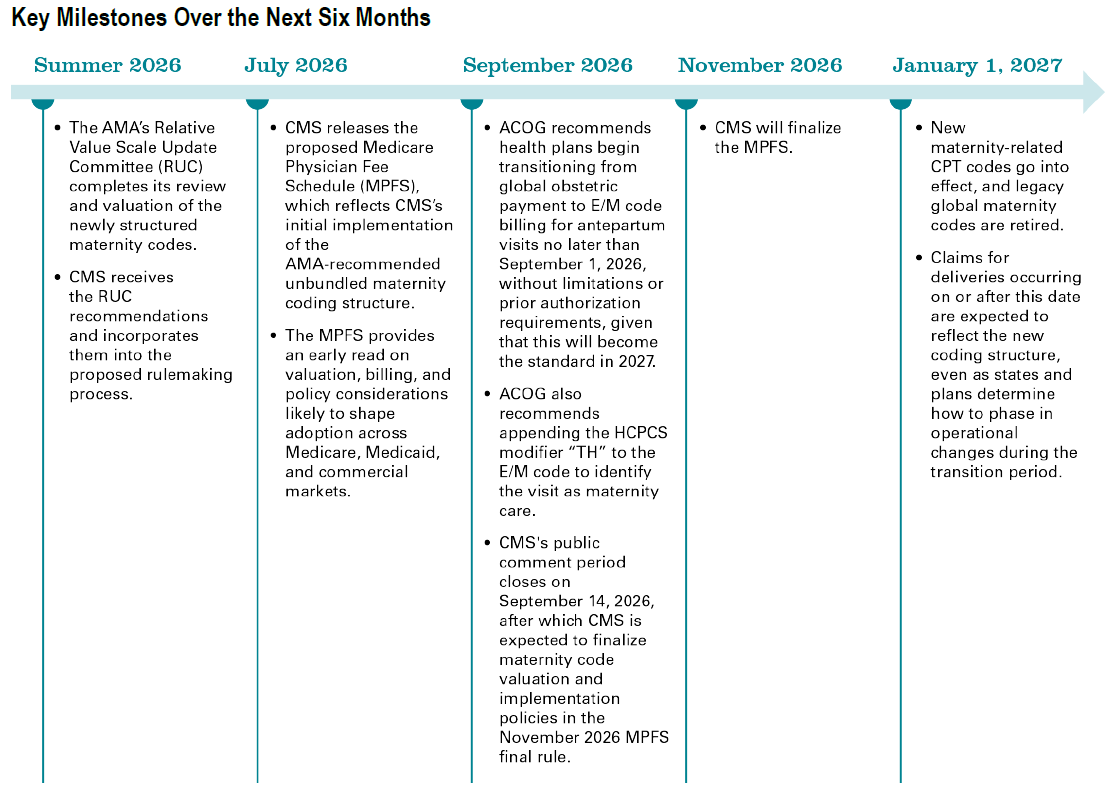
The proposed 2027 Medicare Physician Fee Schedule (MPFS), released on July 14, provides the first indication of how CMS may operationalize maternity care unbundling. CMS generally supports the AMA-developed coding framework, including separate payment for antepartum care, labor management, delivery and postpartum services, while proposing modifications to certain valuation recommendations submitted by the RUC. CMS characterizes the redesign as an opportunity to improve transparency into maternity care delivery, strengthen data available for quality measurement and risk adjustment, and create a stronger foundation for future maternity payment reform. Notably, CMS proposes higher work RVUs than recommended by the RUC for several labor management and delivery services, signaling recognition that portions of maternity care may have been historically undervalued under the global payment structure. At the same time, CMS is seeking comment on potential HCPCS G-codes that could preserve the current global maternity coding and payment structure, including reimbursement that more closely resembles the legacy global payment model, creating an alternative pathway that may balance payment continuity with the transparency benefits of more granular reporting. Importantly, major maternity care stakeholders, including ACOG and the OB Hospitalist Group (OBHG) (the nation’s largest provider of hospital-based OB/GYNs), have publicly urged CMS to avoid creating parallel HCPCS G-codes and instead fully implement the new maternity coding framework, arguing that maintaining elements of the legacy global payment structure would increase administrative complexity and diminish the transparency and attribution benefits of unbundling. CMS’s public comment period closes on September 14, 2026, and a final rule is expected by November.
For more on what health plans, providers, and maternal health innovators should prepare for ahead of January 1, 2027, please read the full report .
E/M codes are the standard CPT codes used to report office visits and other patient evaluation and management services across medical specialties. Diagnostic and procedural codes include services such as obstetric ultrasound, fetal monitoring, amniocentesis, and laboratory testing. While these services have historically been billed using their own CPT codes, they were often delivered as part of a broader maternity episode that was reimbursed through a global maternity payment. The 2027 redesign continues to rely on these existing codes while introducing new maternity-specific codes for labor management and delivery, allowing more components of maternity care to be separately visible and reimbursed.
