
Published On
October 14, 2026
Authors
A Roadmap for Scaling High-Value AI
Manatt Health provided facilitation and research support for the series of workshops and throughout the development of this Peterson Health Technology Institute (PHTI) report.
Key Findings
- AI is fundamentally different from prior health technologies because it can autonomously perform work that previously required human labor and expertise.
- Under current incentives, administrative AI entrenches inefficient workflows and drives inflationary billing, rather than eliminating waste.
- AI has the potential to meaningfully improve clinical care, yet adoption remains limited by the current payment, purchasing, and policy environment.
- Payment reform can accelerate adoption of high-value clinical AI. Outcome-based payment is an important starting point.
Artificial intelligence (AI) has the potential to transform healthcare delivery and administration by performing clinical and administrative tasks that have previously been constrained by human expertise and workforce capacity. If deployed effectively, AI could expand access to care, improve outcomes, and lower spending. Savings generated by health AI should be used to reduce total system costs, including lower premiums and cost-sharing, for patients, employers, and taxpayers.
Whether AI realizes this potential, however, will depend heavily on the financial incentives that guide its deployment. When incentives reward transactions, documentation, billing activity, and administrative processes, AI accelerates those activities. If incentives reward improved patient outcomes, expanded access, and administrative simplification, AI will accelerate those goals. Unfortunately, today’s healthcare system heavily rewards the former—which, left unmanaged, will lead to more administrative activity, complexity, and spending without commensurate improvements in patient outcomes, access, or affordability.
Using AI to drive better health and broader system efficiency will require intentionally building an environment that accelerates high-value AI and discourages uses that inflate profits without delivering system-wide benefits. Supporting new AI-enabled models of care delivery will require coordinated action across multiple market and policy domains, including understanding what works, establishing rules for coverage and use, purchasing effectively, and redesigning care delivery, as illustrated in Exhibit 1.
Exhibit 1: A Roadmap for Scaling High-Value AI
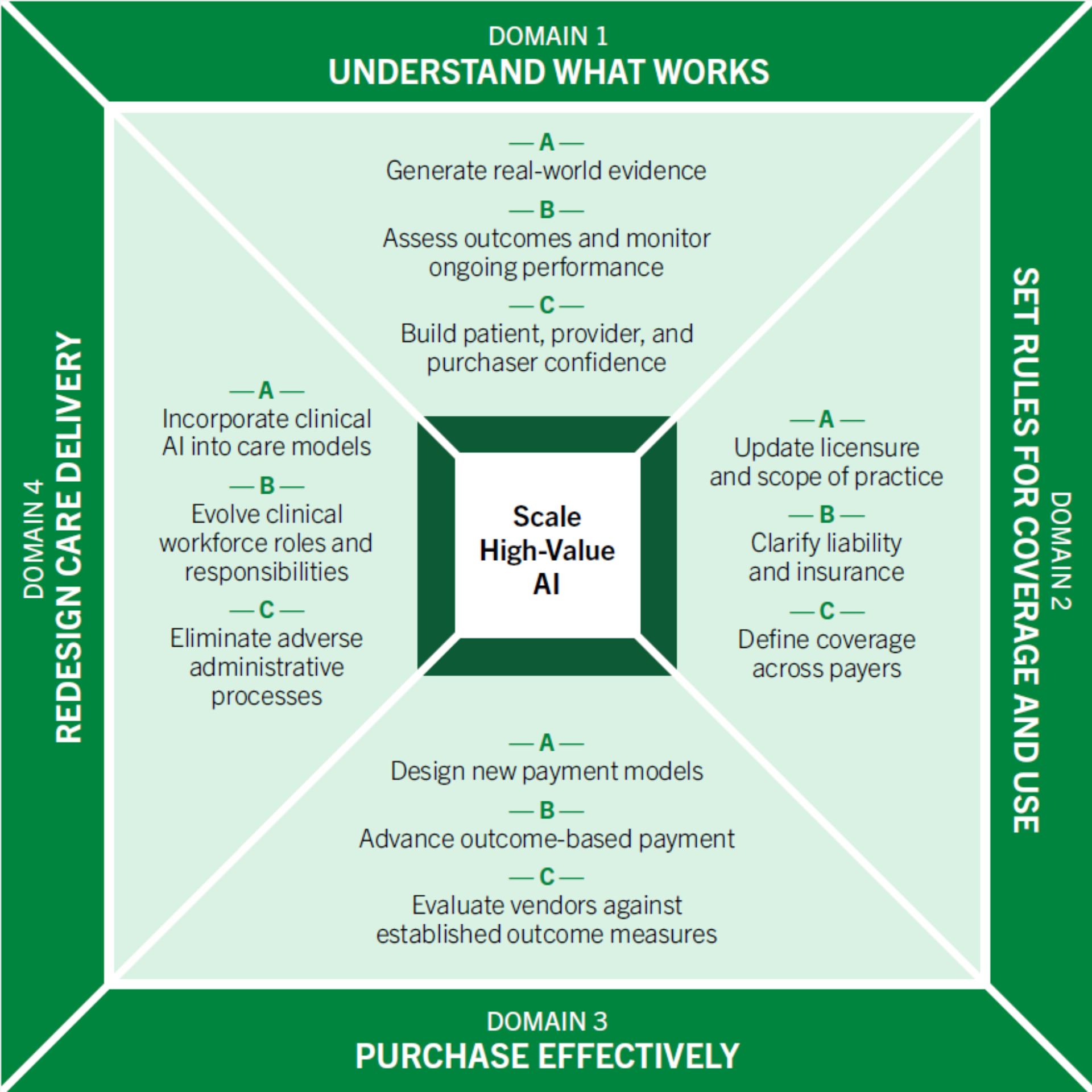
High-Value AI: AI that measurably improves health outcomes, expands access to care, and lowers spending.
AI presents both a generational opportunity and a generational responsibility. Without deliberate action, AI risks amplifying the inefficiencies and costs of today's healthcare system. Under the right conditions, it can expand clinical capacity to meet a growing demand that cannot be addressed by the current workforce alone, improve outcomes, reduce healthcare spending, modernize the workforce, and simplify administration.
Click to read the full report.
